3D STL Models Explained for Businesses and First-Time Users
May 18, 2026
Why OBJ Models with Textures Are Preferred for Realistic 3D Projects
May 20, 2026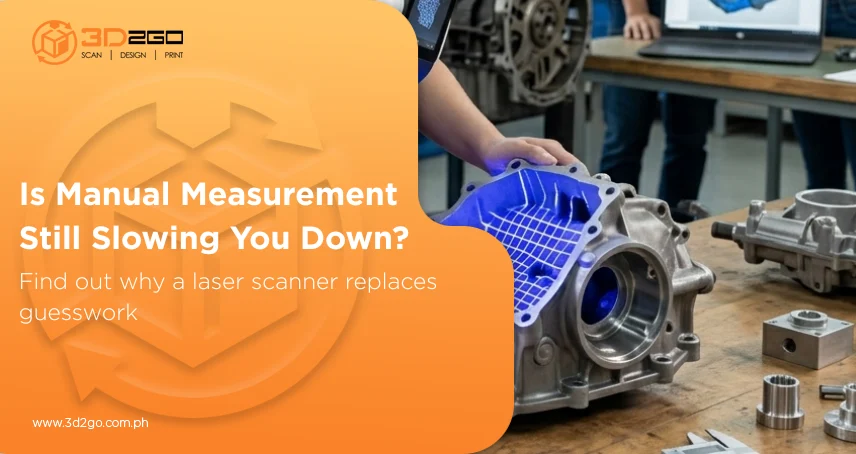
In industries where precision isn’t optional, small errors tend to snowball into expensive problems. A slight misalignment, a missed dimension, or an outdated reference point can derail entire workflows—especially in automotive, equipment maintenance, and industrial production.
That’s why more teams are turning to professional laser scanning solutions to capture real-world objects with a level of detail traditional measurement tools simply can’t match.
A laser scanner doesn’t just measure; it reconstructs. It captures geometry from every angle and converts physical objects into precise digital models that engineers can actually work with.
And once teams get used to that level of accuracy, it’s hard to go back.
What a Laser Scanner Actually Does?
At its core, a laser scanner captures the shape of an object using light-based measurement. It emits laser beams, reads how they reflect off surfaces, and compiles that data into a dense point cloud. That cloud is then processed into a detailed 3D model that closely mirrors the real object.
Unlike manual measuring tools, a laser scanner doesn’t miss curves, angles, or hidden surfaces. It captures everything in one pass—no assumptions, no approximations.
What you get is a complete digital representation that can be used for analysis, redesign, or manufacturing.
Why Vehicles Benefit From Laser Scanning
Vehicles are far more complex than they look at first glance. Underneath the exterior lies a combination of tightly engineered parts, curved surfaces, and precise tolerances that must all align correctly.
A laser scanner simplifies this complexity by capturing the entire structure in one digital model.
That data is especially useful for:
- Damage assessment after collisions
- Custom modification planning
- Replacement part validation
- Design benchmarking
Instead of relying on manual tape measurements or partial sketches, technicians can work directly from a full digital replica.
A laser scanner helps eliminate guesswork, which is often where errors begin in automotive workflows.
Industrial Equipment Needs More Than Estimation
Wear and tear change dimensions over time, and small deviations can affect performance or safety.
A laser scanner allows teams to document equipment exactly as it exists in the real world—without dismantling it or interrupting operations.
That makes it useful for:
- Maintenance planning
- Component reproduction
- Alignment checks
- Structural evaluation
Instead of relying on outdated technical drawings, engineers can work from current, real-world data captured by a laser scanner.
That shift alone can significantly reduce operational uncertainty.
Reverse Engineering Becomes Faster and More Reliable
When original CAD files are missing or outdated, scanning becomes the fastest way to recreate accurate digital models.
A laser scanner captures geometry from an existing physical object, which can then be rebuilt, modified, or improved in CAD software.
This is especially valuable for:
- Legacy equipment
- Discontinued parts
- Custom-built systems
- Hard-to-source components
Instead of starting from scratch, teams can build from reality.
Accuracy Directly Impacts Cost and Efficiency
Measurement errors don’t always show up immediately—but when they do, they’re expensive. Incorrect dimensions often lead to rework, wasted materials, and production delays.
A laser scanner helps reduce these risks by providing a highly accurate reference model from the beginning. With more reliable data, teams spend less time correcting mistakes and more time moving forward with actual production work.
Better Collaboration Across Technical Teams
Miscommunication between teams is a common issue in complex projects. Designers, engineers, and production teams often work from different interpretations of the same object.
A laser scanner helps solve this by creating a shared digital reference that everyone can use. Instead of relying on separate drawings or explanations, teams work from the same scanned model.
That consistency reduces misunderstandings and speeds up decision-making across departments.
Handling Complex Shapes Without Extra Effort
Some objects are just difficult to measure manually. Curved surfaces, irregular geometry, and tightly packed components often require time-consuming workarounds.
A laser scanner handles these shapes naturally by capturing millions of data points across the surface of an object. There’s no need to simplify or estimate geometry—the scanner records it as it is.
This makes it especially useful for industrial parts, automotive components, and custom machinery.
Speed Matters Just as Much as Precision
In many industries, time is just as valuable as accuracy. A laser scanner dramatically reduces the time needed to capture full measurements compared to manual methods.
What might take hours of physical measuring can often be completed in a fraction of the time. That speed allows teams to move faster from inspection to design to production, keeping projects on schedule and reducing downtime.
And in industrial environments, those time savings add up quickly.
From Physical Object to Digital Workflow
Modern manufacturing depends heavily on digital integration. A laser scanner serves as the bridge between physical objects and digital systems such as CAD software, simulation tools, and 3D printing workflows.
Once scanned, objects can be analyzed, modified, or reproduced with high accuracy. This connection between physical and digital workflows is becoming a core part of how industries operate today.
Common Misunderstandings About Laser Scanning
A laser scanner is sometimes seen as overly complex or only suitable for large industrial setups, but that’s not really the case.
While it does excel in industrial environments, it’s also used in product design, quality control, and prototyping workflows.
Another misconception is that scanning replaces skilled professionals. In reality, it enhances their work by providing them with better data to make decisions. The scanner doesn’t remove expertise—it supports it.
Better Workflows Start With Better Capture
In industries where precision matters, assumptions are risky.
A laser scanner reduces that risk by capturing real-world objects with a level of accuracy that manual methods can’t consistently match. It improves workflows across vehicles, equipment, and industrial parts by providing reliable digital data from the start.
As industries continue shifting toward digital-first workflows, scanning technology is becoming less specialized and more of a standard requirement.
3D2GoPH provides professional scanning solutions designed to help businesses capture precise, production-ready data for engineering, manufacturing, and design applications.