
Why a High-Quality Digital Model Saves Time in Product Development
May 12, 2026
From Real Vehicle to Digital Replica Using a 3D Laser Scanning Device
May 14, 2026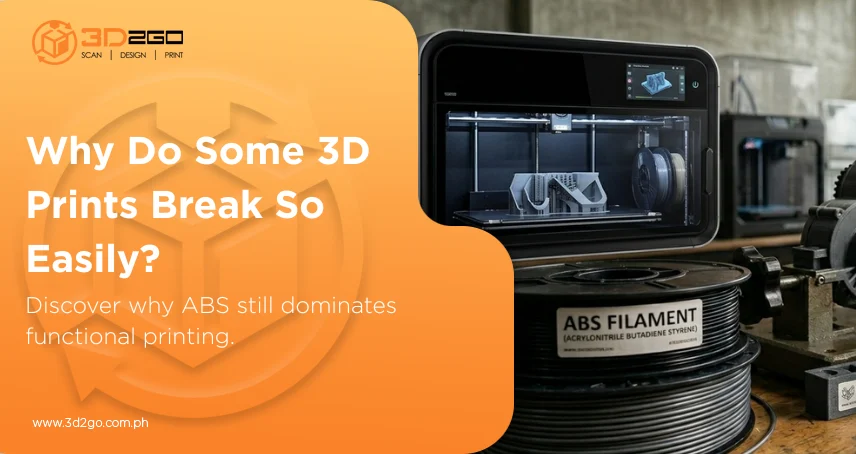
A 3D print can look flawless on the outside and still fail the moment real pressure hits it. That’s the difference between decorative printing and functional printing. Some projects are meant to sit on display, while others need to survive heat, impact, repeated handling, and real-world wear without cracking apart after a few uses.
This is where ABS material 3D printing continues to stand out.
For years, abs 3d printer filament has remained one of the most trusted materials for strong, functional prints because it offers something many standard filaments struggle to balance consistently—durability, flexibility, and reliable performance under stress.
And despite newer materials constantly entering the market, ABS still earns its place in serious production workflows where strength actually matters.
ABS Was Designed for Tougher Applications
Not all plastics behave the same way under pressure. Some become brittle quickly. Others warp too easily or lose shape when heated. ABS takes a different approach. The material was designed to withstand harsher environments where durability matters more than surface appearance alone.
That’s one reason abs 3d printer filament became widely used long before desktop 3D printing exploded in popularity. ABS already had a strong reputation across industries because it was commonly used in automotive parts, protective casings, helmets, and consumer products that required impact resistance.
The material simply holds up better under stress compared to many entry-level alternatives. And in functional printing, that difference becomes obvious fast.
Impact Resistance Changes Everything
Many materials perform well until they’re dropped. ABS is different because it absorbs force more effectively than brittle plastics that tend to crack under sudden impact. Instead of snapping immediately, ABS 3D printer filament has enough flexibility to withstand stress without completely failing.
That toughness makes it especially useful for:
- Functional prototypes
- Mechanical components
- Product testing
- Protective housings
- Industrial applications
For businesses testing products in real-world conditions, durability isn’t optional. Weak prototypes yield unreliable test results because the material fails before the design can be properly evaluated.
ABS helps avoid that problem.
Heat Resistance Makes ABS More Reliable
Temperature resistance is another reason ABS 3D printer filament remains relevant in professional workflows.
Certain filaments soften surprisingly fast when exposed to moderate heat. ABS performs much better in warmer environments, making it more dependable for parts used near electronics, machinery, or enclosed spaces where temperatures fluctuate regularly.
That added thermal resistance helps printed parts maintain their structure and functionality, rather than warping under pressure.
And for engineering or industrial use, consistency matters just as much as strength.
ABS Creates Better Functional Prototypes
Not every prototype is made solely for visual presentation. Some prototypes need moving parts. Others need structural testing. In many cases, businesses need to evaluate a product’s physical behavior before committing to manufacturing.
That’s where abs 3d printer filament becomes extremely valuable.
Because the material is tougher and more impact-resistant, prototypes can handle more realistic testing conditions. Designers and engineers can assess fit, movement, assembly, and durability with greater confidence, rather than treating the print as a fragile display piece.
That leads to more accurate product validation early in development.
The Material Handles Post-Processing Well
One underrated advantage of abs 3d printer filament is how workable it is after printing.
ABS can be sanded, drilled, cut, glued, and refined more easily than many beginner-friendly materials. That flexibility gives creators more control during finishing and assembly.
For projects that require smoother surfaces or additional modifications, ABS offers the flexibility to refine without sacrificing structural integrity.
That balance between strength and workability is part of what keeps the material widely used even today.
ABS Still Holds Its Ground Against Newer Materials
The 3D printing industry constantly introduces new materials promising better performance, faster printing, or easier handling.
Yet despite all those newer options, ABS 3D printer filament remains one of the most trusted materials for functional applications.
Why? Because ABS consistently delivers reliable results where it counts.
Some advanced materials offer impressive features but require expensive equipment or highly specialized workflows. ABS remains practical while delivering strong mechanical performance across a wide range of applications.
It’s not flashy. It’s dependable. And in production environments, dependable usually wins.
Proper Printing Conditions Matter With ABS
ABS is strong, but it’s also less forgiving than beginner-oriented materials. Because ABS 3D printer filament reacts noticeably to temperature fluctuations, printing conditions need to be kept under control throughout the process. Poor temperature control can lead to warping, cracking, or weak layer adhesion.
That’s why professional setups often use enclosed printers and carefully calibrated settings when handling ABS projects.
The material rewards precision.
When printed properly, ABS produces parts that feel significantly more durable and reliable than those made with softer, lower-strength alternatives.
Strong Materials Are Becoming More Important Across Industries
As additive manufacturing expands into industrial and commercial applications, businesses are demanding materials that can do more than create visual concepts.
According to Statista, industries worldwide continue to increase investments in additive manufacturing technologies for both prototyping and production workflows.
That growth naturally increases demand for materials like abs 3d printer filament, especially in applications where durability, impact resistance, and long-term performance matter.
Because once 3D printing moves beyond hobby use, material quality becomes a much bigger conversation.
ABS Supports Real-World Applications
A lot of people still associate 3D printing with miniatures or display models.
But abs 3d printer filament is regularly used for much more demanding applications, including:
- Engineering prototypes
- Industrial fixtures
- Functional product parts
- Mechanical testing components
- Protective enclosures
- Automotive-related projects
Its durability enables printed parts to approach real-world functionality rather than remain purely conceptual.
That’s a major reason ABS continues to play such a strong role in modern 3D printing.
Stronger Prints Start With Smarter Material Choices
A printer alone doesn’t determine print quality. Material choice plays just as big a role in how durable, reliable, and functional the final result becomes.
The long-standing reputation of abs 3d printer filament stems from its ability to combine strength, flexibility, heat resistance, and practical performance into a single dependable material. For businesses creating functional prototypes or durable parts, reliability matters far more than trends or marketing hype.
As 3D printing continues expanding into real-world production, strong materials will only become more important.
3D2GoPH helps businesses produce high-quality prints with reliable materials and optimized workflows, delivering stronger, more dependable results from concept to production.