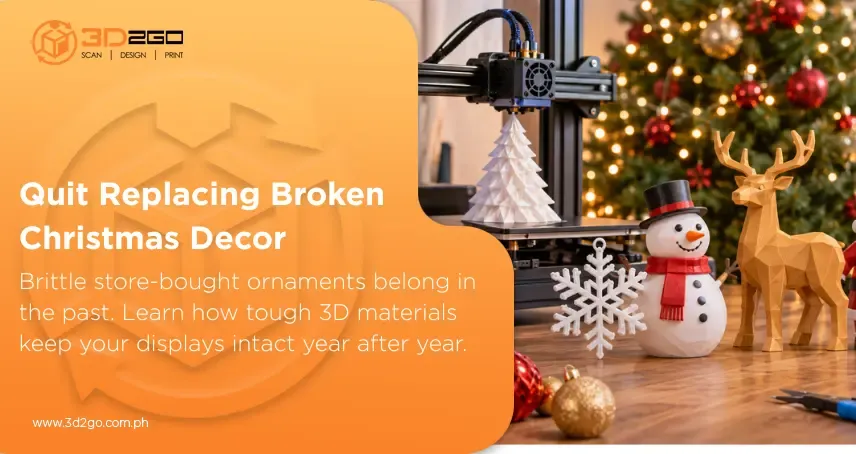
Nothing kills the holiday mood faster than cracking open your storage bins in November and finding shattered ornaments, snapped reindeer antlers, and warped tree toppers. Most store-bought decor is injection-molded from cheap, brittle plastic that barely survives two seasons of packing and unpacking. Printing your own festive pieces—or commissioning custom displays for a commercial space—gives you a rare chance to make holiday decor that lasts for years.
Getting your 3D printing material selection right is what separates a throwaway novelty from a centerpiece you’ll pull out every December. Whether you’re printing delicate snowflakes for a living room tree, glowing village houses, or oversized outdoor displays for a storefront, the filament or resin you choose has to match where the piece will live. Relying on strong 3D printing materials keeps fragile parts from snapping mid-season, cuts down on plastic waste, and saves you from reprinting the exact same pieces every single year.
Why Standard Plastics Fail During the Holidays
Holiday decor takes more of a beating than most people realize. In a warm, humid climate like the Philippines, decorations sit in hot storage rooms or attics for ten months before being hauled out, handled by rushed decorators, and packed away again.
Basic hobbyist plastics might look sharp fresh off the print bed, yet they usually fail in three predictable ways:
- Heat Distortion: Leaving standard prints in a non-air-conditioned stockroom or right next to warm string lights can cause thin walls to droop and lose their shape.
- Impact Brittleness: Drop a rigid ornament onto a tiled floor, and it’ll usually shatter on impact.
- UV and Moisture Wear: Outdoor porch figures or window displays hit by direct afternoon sun and rain quickly turn faded, chalky, and brittle.
Switching to strong 3D printing materials solves those weak spots before your printer even heats up.
Comparing the Best Filaments and Resins for Holiday Decor
Not every holiday piece needs industrial-grade armor. A lightweight bauble hanging on a pine branch faces totally different stress than a freestanding nativity figure out on the lawn.
1. PETG (Polyethylene Terephthalate Glycol)
If you want one reliable all-rounder for indoor holiday prints, start with PETG. It prints almost as easily as basic hobby filaments while offering much better impact resistance and heat tolerance.
- Best For: Hanging ornaments, LED light diffusers, window snowflakes, and covered porch decor.
- Why It Works: PETG has just enough natural give that if an ornament slips out of your hand while trimming the tree, it’s far more likely to bounce than break. Translucent PETG also diffuses warm LED lights cleanly without softening from the bulb’s heat.
2. ASA (Acrylonitrile Styrene Acrylate)
When your decorations are heading outside onto a garden, building facade, or open patio, ASA is easily one of the smartest strong 3D printing materials on the shelf. It packs the mechanical toughness of industrial ABS with built-in resistance to UV rays and rough weather.
- Best For: Outdoor lawn figures, rooftop displays, weather-exposed signage, and exterior lanterns.
- Why It Works: Standard plastics yellow and crack after a few weeks in harsh sun, whereas ASA keeps its color and rigid structure through intense heat, humidity, and heavy rain.
3. ABS (Acrylonitrile Butadiene Styrene)
ABS is the exact same tough thermoplastic used in classic interlocking toy bricks. It shrugs off heat and takes post-processing—like sanding and vapor smoothing—like a champ.
- Best For: Moving mechanical displays, snap-fit village houses, and glossy painted centerpieces.
- Why It Works: Its higher heat resistance keeps your prints from warping inside sweltering storage boxes over the summer.
4. Tough and Engineering-Grade Resins
Standard photopolymer resins capture incredible detail, though they’re notoriously brittle if dropped. Modern “tough” or ABS-like resins fix that headache, making them fantastic, strong 3D printing materials for intricate tabletop pieces.
- Best For: Detailed nativity figurines, heirloom ornaments, and delicate filigree work.
- Why It Works: Tough resins hold crisp facial features and fine textures without snapping the second someone accidentally knocks a figurine off a shelf.
| Material Type | Impact Resistance | Heat & Storage Tolerance | Outdoor / UV Stability | Ideal Holiday Application |
| PETG | High (slight flex) | Moderate to High | Good | Ornaments, LED diffusers, tree toppers |
| ASA | Very High | High | Excellent | Outdoor displays, yard stakes, facade decor |
| ABS | High | High | Low (needs paint) | Snap-fit parts, mechanical displays |
| Tough Resin | Moderate to High | Moderate | Low (indoor only) | Detailed figurines, tabletop villages |
Cutting Seasonal Waste with Smarter Material Choices
Nobody wants to keep throwing away broken plastic every January. Building your decor with strong 3D printing materials fits right into that mindset. Instead of tossing cracked store-bought pieces into the trash and buying replacements next year, well-built prints stay in rotation for seasons to come. Even better, if one piece of a modular display ever gets damaged, you only reprint that single part rather than scrapping the whole set.
Design and Slicer Tweaks That Boost Durability
Even the toughest filament won’t rescue a poorly sliced file. Pairing strong 3D printing materials with a few smart slicer adjustments dramatically extends the life of your prints:
- Add Wall Perimeters Instead of Heavy Infill: Most of a print’s real-world strength lives in its outer shell, not the internal grid. Bumping your wall count from 2 to 3 or 4 perimeters keeps ornaments from getting crushed inside packed bins.
- Pick Smarter Infill Patterns: Go with Gyroid or Cubic infill at 15% to 25% for structural parts. Both spread stress evenly in every direction instead of leaving weak shear lines.
- Round Out Sharp Corners: Sharp 90-degree joints trap stress and act like built-in snap points. Adding small fillets to internal corners keeps antlers, tree branches, and hanging hooks from breaking off during handling.
- Watch Your Layer Orientation: Print hanging loops and thin arms flat along the build plate whenever you can. Layer lines are always the weakest link in FDM printing, so aligning stress along continuous filament strands keeps hooks from shearing off under weight.
Off-Season Storage Habits That Protect Your Prints
Once January arrives, how you pack everything away matters almost as much as how you printed it. Even strong 3D printing materials last longer with a little common-sense care:
- Use Divided Bins: Keep heavy centerpieces from crushing smaller ornaments by packing them in rigid totes with cardboard or foam dividers.
- Stay Away from Roof Heat: Store your bins in a cool, dry closet rather than under an uninsulated metal roof, where afternoon temperatures can easily climb past 50°C.
- Wrap Delicate Details Loosely: Cushion thin resin figurines in soft tissue paper or bubble wrap instead of wedging them tightly into cramped boxes.
Build Lasting Holiday Displays with 3D2GoPH
Pulling off custom seasonal decor—whether for your own home, a boutique retail window, or a full-scale mall installation—takes more than hitting print on a downloaded file. Getting clean finishes, true color accuracy, and real structural durability comes down to pairing industrial-grade machines with strong 3D printing materials matched to your exact setup.
At 3D2GoPH, we help event stylists, designers, businesses, and creators across the Philippines turn custom holiday concepts into tough, display-ready pieces. As the country’s premier end-to-end 3D service hub, we handle professional FDM and high-detail resin printing with UV-resistant polymers, engineering filaments, and tough resins—plus sanding, smoothing, and custom painting. Whether you need a run of branded corporate ornaments or oversized outdoor displays built to handle tropical weather, we make sure your prints look sharp and hold up year after year.
Ready to bring your custom holiday designs to life without worrying about fragile prints? Contact our 3D printing specialists today to discuss your project requirements and get a quote for your next build!
Key Takeaways
- Match Material to Environment: Choose PETG for shatter-resistant indoor ornaments and LED diffusers, and ASA for sun- and rain-exposed outdoor pieces.
- Upgrade Resin for Fine Details: Choose tough or ABS-like resins over standard brittle formulas when printing detailed tabletop figurines.
- Strengthen Through Slicing: Prioritize extra wall perimeters (3–4 walls) and smart layer orientation so thin parts don’t snap during packing.
- Cut Down Seasonal Waste: Durable, strong 3D printing materials eliminate yearly replacements and let you reprint single damaged parts instead of whole sets.