Few things in facility management or industrial maintenance are more frustrating than a single cracked gear, sheared bracket, or broken housing bringing an entire machine to a dead stop. You call the original manufacturer, only to hear the dreaded response: the part is obsolete, the vendor went out of business, or overseas lead times stretch into several months.
For years, operations teams faced two bad options: scrap working equipment for an expensive replacement system or pay a local machine shop steep fees for low-volume CNC fabrication. Modern additive manufacturing completely rewrites that script. Using custom 3D printed components lets you bypass legacy supply chains and reverse-engineer lost geometry down to the exact millimeter. Sourcing 3D printed replacement components gives maintenance teams a reliable way to keep critical hardware running without long operational delays or inflated maintenance costs.
The High Cost of Legacy Supply Chain Bottlenecks
Traditional manufacturing relies heavily on massive volume runs. Injection molding plants produce tens of thousands of identical plastic components in a single batch to justify high steel tooling costs. Once a product line gets retired, factory spare parts quickly vanish from warehouse shelves.
When an obsolete component breaks, traditional procurement runs into brick walls:
- Extremely Long Lead Times: Sourcing rare spare parts from overseas suppliers can take six to twelve weeks, keeping key equipment idle.
- Forced System Upgrades: Equipment manufacturers often use discontinued parts to nudge clients into buying newer, high-cost machine models.
- High Minimum Orders: If a vendor agrees to spin up a legacy part, they typically require minimum order quantities in the hundreds or thousands.
Sourcing 3D printed replacement components eliminates these supply chain hurdles by fabricating parts on demand, right when you need them. According to a research industrial manufacturers now rely on additive manufacturing specifically for spare parts supply and rapid tooling, cutting inventory holding costs and slashing unplanned equipment downtime.
Why Printing Obsolete Components Makes Financial Sense
Digital fabrication isn’t just a temporary patch—it’s a long-term engineering fix. Recreating legacy hardware through additive technology brings distinct operational perks:
- Production on Demand: You make exactly what you need when you need it, avoiding clutter in parts storage.
- Upgraded Material Properties: Factory plastic parts often fail because of low-cost base resins. 3D printing lets you upgrade to durable engineering polymers, carbon fiber blends, or high-impact resins.
- Design Tweaks & Reinforcement: If a factory bracket always snaps at a specific stress point, engineers can reinforce the weak geometry in CAD before printing the replacement.
- Zero Custom Tooling Costs: 3D printers build parts directly from digital CAD files, skipping the heavy mold tooling fees associated with factory runs.
Investing in 3D printed replacement components helps facility teams extend the working life of legacy hardware while keeping maintenance budgets under control.
Where Printed Replacement Parts Deliver the Best ROI
Obsolete part reproduction offers clear practical value across a wide range of industrial and commercial setups:
- Manufacturing & Packaging Lines: Replacing worn conveyor gears, sensor mounts, suction nozzles, and custom alignment guides that OEMs no longer stock.
- HVAC & Commercial Facilities: Recreating custom valve handles, duct connectors, louvers, and hard-to-find mounting clips for older air conditioning systems.
- Fleet & Heavy Machinery: Reproducing interior trim panels, dash knobs, custom brackets, and specialized engine bay fixtures.
- Commercial Equipment: Printing custom battery covers, gear assemblies, and outer casings for high-value hardware no longer backed by factory warranties.
Relying on 3D printed replacement components keeps vital equipment operational, saving companies from premature asset write-offs.
Reverse Engineering: From Broken Sample to Ready-to-Install Part
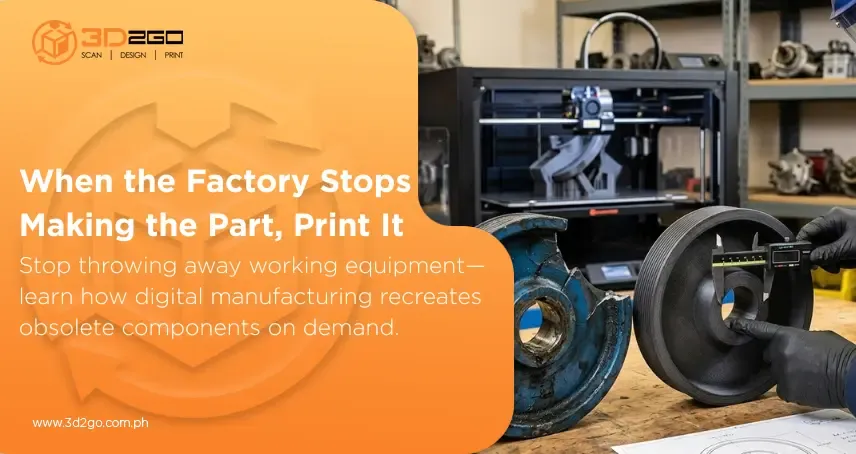
You don’t need original factory blueprints to reproduce a discontinued component. Through reverse engineering and digital spatial measurement, technical teams can rebuild accurate digital files straight from worn or broken physical parts.
When you order 3D printed replacement components, your part goes through a systematic engineering workflow:
- Digital Capture & Measurement: Technicians use high-precision 3D scanners, calipers, and gauges to log every surface contour, mounting hole, and mechanical tolerance.
- CAD Repair & Geometry Cleanup: Engineers recreate the part in CAD software, repairing cracked edges, restoring worn gear teeth, and beefing up known failure points.
- Material & Slice Setup: Choosing the right resin or engineering filament based on heat resistance, tensile load, and exposure to oils or friction.
- Precision Fabrication: Industrial 3D printers build the part layer by layer, maintaining tight dimensional accuracy.
- Post-Processing & Quality Verification: Sanding, curing, or heat-treating the part to ensure a perfect fit and smooth mechanical operation.
A structured 3D printed replacement components pipeline guarantees your replacement part drops smoothly into existing machinery on the first try.
Selecting the Right Filament or Resin
Not all 3D printing materials handle stress the same way. Matching the material to your operational environment is key to long-term performance:
Engineering Thermoplastics (FDM Printing)
Materials like PETG, ABS, Nylon, and carbon-fiber-filled filaments excel at structural brackets, functional gears, and impact-resistant housings subject to everyday mechanical wear.
Photopolymer Resins (SLA Printing)
High-precision resins work best for ultra-smooth, fine-detail parts like small internal gears, custom dials, and delicate enclosures where tight tolerances are critical.
Consulting specialists in 3D printed replacement components ensures your final component stands up to the exact friction, heat, and load requirements of your application.
Keep Operations Moving Without Supply Chain Delays
A single discontinued part shouldn’t force you to scrap valuable machinery or endure weeks of costly operational delays. Digital manufacturing gives you full control over your equipment maintenance, letting you reproduce rare components quickly and affordably.
Using custom 3D printed replacement components bridges the gap between legacy hardware and modern digital fabrication. Digitizing your spare parts management lets you repair, reinforce, and optimize physical assets whenever maintenance issues pop up.
Recreate Hard-to-Find Parts with 3D2GoPH
Unexpected hardware failures usually bring unwanted downtime and bloated repair bills. Relying on slow overseas supply chains or hunting down rare parts on second-hand sites puts your operations at serious risk.
3D2GoPH helps businesses, technicians, and facility operators eliminate spare part uncertainty. As a full-service 3D technology provider in the Philippines, we manage the entire replacement pipeline under one roof—from high-resolution 3D scanning and reverse-engineered CAD design to industrial 3D printing and hand-finishing. Our engineering team delivers accurate, functional components built to your exact mechanical needs.
Don’t let a discontinued part hold your operations hostage. Skip the long lead times and get your equipment back in action. Contact our team today to start recreating your replacement components with total precision!