Before Groundbreaking: How 3D Visualization Rendering Helps Secure Project Buy-In
July 8, 2026
From Thesis Projects to Product Launches: Where a 3D Printing Prototype Service Delivers the Most Value
July 10, 2026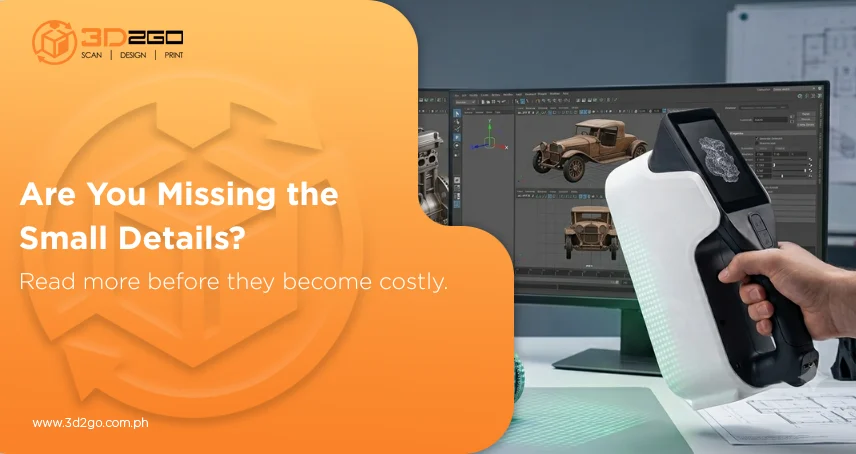
It could be a discontinued machine component, a handcrafted product without a digital design file, or a custom-made part requiring an exact replacement. Measuring every tiny feature by hand takes time, and even then, small inaccuracies can create costly problems later.
That’s why more businesses are adopting a scan to 3D model workflow. Instead of rebuilding an object from scratch, they first capture it digitally. The result is a detailed model that preserves the original shape, dimensions, and surface features with remarkable accuracy.
It’s one of the biggest reasons 3D scanning small objects has become an essential process for replication, reverse engineering, and custom manufacturing.
Small Parts Leave Very Little Room for Error
Working with small objects can be surprisingly challenging. Even a fraction of a millimeter can affect how a replacement part fits or how a finished product performs.
While tools like calipers and rulers are still useful, they’re limited when dealing with complex curves, textured surfaces, or intricate details.
That’s where 3D scanning small objects offers a clear advantage. Instead of recording only a few dimensions, the scanner captures thousands—sometimes millions—of points across the object’s surface, creating a complete digital representation instead of a collection of manual measurements.
Replication Starts With Accurate Data
When an object needs to be recreated, accuracy matters from the very beginning. Whether it’s an industrial component, a handcrafted item, a consumer product, or a collectible, starting with incomplete measurements often means spending more time correcting mistakes later.
With 3D scanning small objects, businesses begin with a highly accurate digital copy of the original. Designers can then refine the model, prepare it for manufacturing, or archive it for future use without repeatedly measuring the physical item.
A Practical Tool for Reverse Engineering
Reverse engineering usually begins with one simple challenge: there’s no existing CAD file. The original drawings may have been lost, the manufacturer may no longer exist, or the part may have been modified over time.
Instead of trying to recreate everything manually, engineers use 3D scanning small objects to capture the physical part exactly as it exists today.
The scan becomes a reliable reference for building CAD models, analyzing designs, improving existing components, or manufacturing compatible replacements.
Better Manufacturing Begins With Better Information
Every manufacturing process depends on the quality of its starting data. If measurements are inaccurate, those errors often carry through production, leading to poor fit, wasted materials, and unnecessary rework.
According to research, manufacturers continue investing in digital technologies because they improve operational efficiency, reduce production errors, and support better product quality throughout the manufacturing process.
That’s exactly where 3D scanning small objects fits into today’s digital workflow. By replacing manual estimation with precise scan data, manufacturers can work with greater confidence throughout the design and production process.
Bringing Obsolete Parts Back to Life
Many industries still rely on equipment that’s been in service for years, sometimes decades. The challenge comes when a critical component fails and replacement parts are no longer available.
Instead of redesigning an entire assembly, companies can use 3D scanning small objects to digitize the existing part and recreate it with modern manufacturing methods.
It’s a practical solution that helps extend the life of valuable equipment without waiting for impossible-to-find replacements.
Capturing Details That Traditional Measurements Miss
Not every object is made up of straight edges and flat surfaces. Decorative engravings, organic curves, intricate mechanical features, and irregular geometries can be difficult to document using conventional tools.
Because 3D scanning of small objects records the entire surface rather than selected dimensions, designers receive a much richer dataset to work with.
That level of detail reduces guesswork and produces digital models that stay much closer to the original object.
Helping Product Development Move Faster
Developing a new product often means improving an existing one. When engineers already have a physical sample, manually rebuilding it into a CAD model can consume valuable time before any real design work even begins.
Using 3D scanning small objects, much of that groundwork is completed in a single capture. Instead of recreating every feature from scratch, design teams can focus on refining, testing, and enhancing the product much earlier in the development cycle.
Making Quality Inspection More Reliable
Scanning doesn’t stop once manufacturing begins. Many companies also use 3D scanning small objects as part of their quality inspection process.
Finished components can be compared against their digital models to identify dimensional differences before products move further down the production line.
Finding small deviations early helps reduce waste, improve consistency, and prevent expensive corrections later.
Protecting Valuable and Fragile Items
Some objects simply can’t be measured over and over again. Historical artifacts, museum collections, delicate prototypes, and handcrafted pieces require a non-contact approach that minimizes handling.
With 3D scanning small objects, organizations can preserve detailed digital records without putting the original item at unnecessary risk.
Those digital files become valuable references for restoration, documentation, research, or future reproduction whenever they’re needed.
The Foundation of Modern Digital Manufacturing
Today’s engineering and manufacturing processes depend on accurate digital information. Whether the next step is CAD modeling, CNC machining, simulation, or 3D printing, every workflow benefits from reliable source data.
That’s why 3D scanning small objects has become a valuable first step. Instead of designing around assumptions, engineers begin with an accurate representation of the real object.
The result is a smoother workflow, fewer revisions, and greater confidence throughout production.
Turning Physical Objects Into Digital Precision
As products become more detailed and manufacturing continues to evolve, accurate digital data is becoming just as important as the finished product itself.
3D scanning small objects helps businesses create precise digital models for replication, reverse engineering, product development, and custom manufacturing. Every scan is designed to capture the details that matter, giving your team a dependable foundation for the next stage of the project.
Need an accurate digital model of an existing part or product? Visit us and see how 3D2GoPH can help transform physical objects into production-ready digital assets.