
Launch Before You Manufacture: Why Brands Invest in 3D Product Rendering Services
June 30, 2026
What Can You Build with Large Scale 3D Printing That Traditional Methods Struggle to Produce?
July 2, 2026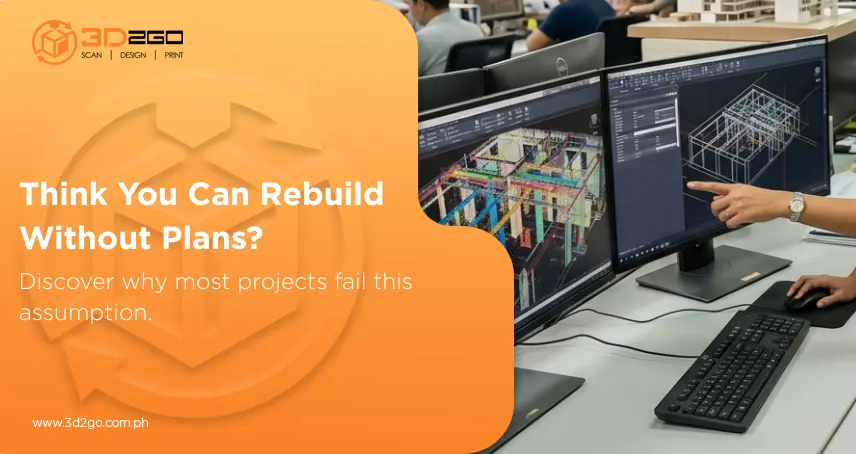
When there’s no reliable set of blueprints to work from, projects don’t usually fail right away. The problems tend to surface later—when dimensions don’t line up, components clash on-site, or a “minor adjustment” suddenly becomes a major redesign.
This is where precision 3D scanning steps in as a practical way forward. Through modern laser scanning services, existing spaces and structures can be captured in full detail and turned into accurate digital references that reflect reality—not estimates.
Why Missing Blueprints Slow Everything Down
At first glance, missing documentation might not feel like a critical issue. Teams often assume they can just re-measure what they need and move forward.
Architects end up revisiting sites multiple times. Engineers discover inconsistencies only after fabrication starts. Contractors are forced to pause work while details are double-checked.
That’s why laser scanning services are now widely used as a starting point for renovation, retrofit, and complex site upgrades. Instead of piecing information together, teams capture everything in one coordinated scan.
How Laser Scanning Services Capture Reality
Unlike traditional measuring tools that rely on selected points, laser scanning services collect millions of spatial data points across surfaces, structures, and objects.
What you get is a dense digital representation of the real environment—often called a point cloud—which can later be converted into CAD files or BIM-ready models.
Nothing is assumed, skipped, or approximated. Even uneven surfaces, hidden corners, and hard-to-reach sections are recorded with consistency.
With laser scanning services, the site is documented as it is, not as it was expected to be.
Turning Physical Sites Into Reliable Digital Models
One of the most practical outcomes of laser scanning services is the ability to turn existing structures into usable digital models.
Instead of relying on outdated drawings or fragmented notes, teams can work from a single, accurate source of truth.
This improves coordination across design, engineering, and construction teams. Everyone sees the same environment and interprets it the same way.
As a result, discussions become clearer, and decisions happen faster—because there’s less room for misinterpretation.
In most modern workflows, laser scanning services are no longer treated as optional. They’ve become part of the foundation for any project involving existing conditions.
Cutting Down Costly Rework Before It Starts
Rework is one of those problems that quietly drains budgets. It usually doesn’t show up until something is already built, installed, or fabricated incorrectly.
Laser scanning services help catch those issues earlier by revealing misalignments, structural deviations, or unexpected site conditions before work begins.
Common examples include:
- Walls or structures that aren’t perfectly aligned
- Clearance issues for equipment installation
- Hidden deviations in older buildings or modified spaces
The earlier these issues are identified, the easier—and cheaper—they are to address.
What Research Says About Rework Costs
Industry data consistently shows how expensive rework can become. According to research, rework can account for approximately 5% to 15% of total project costs in construction environments.
That’s not a small margin—it’s often the difference between a profitable project and a strained one. This is one reason laser scanning services are increasingly used upfront. They reduce uncertainty before it turns into financial loss.
Where Traditional Measurement Breaks Down
Manual measurement still has its place, but it struggles in environments that are large, irregular, or heavily modified over time.
A tape measure can only capture what’s directly in front of it. Everything else depends on interpretation.
Laser scanning services remove much of that uncertainty by capturing full spatial environments in a single process. Instead of isolated measurements, teams get a complete dataset they can revisit anytime.
For older facilities or undocumented structures, this approach often becomes the only dependable way to rebuild accurate records.
Supporting Renovation, Retrofits, and Reverse Engineering
In renovation work, laser scanning services help teams understand real-world conditions before making design decisions.
In retrofits, they ensure new systems fit within existing constraints. In reverse engineering, they allow physical components to be digitally reconstructed for redesign, duplication, or analysis.
Across all these scenarios, laser scanning services act as a bridge between physical reality and digital planning.
Improving Coordination Across Teams
One of the less obvious benefits of laser scanning services is improved communication.
When every team is working from a different interpretation of a site, misunderstandings are almost guaranteed. But when everyone references the same scan-derived model, alignment improves naturally.
Design teams can highlight issues visually. Engineers can validate constraints faster. Contractors can plan execution with fewer assumptions.
That shared understanding is often what keeps complex projects on schedule.
From Raw Data to Practical Use
Capturing data is only the beginning. Once processed, laser-scanning outputs can be integrated into CAD systems, BIM platforms, or simulation tools. This allows teams to measure, adjust, and plan with a level of accuracy that traditional methods simply can’t match.
Instead of working around uncertainty, decisions are based on verified spatial data.
A More Stable Starting Point for Complex Projects
When original blueprints are missing, projects don’t need to slow down—they need a better starting point.
That’s what laser scanning services provide. They replace uncertainty with measurable reality, giving teams a clearer path forward before design or construction begins.
It’s not just about documentation. It’s about reducing risk before it turns into rework, delays, or unexpected costs.
Bringing Accuracy Back Into the Process
At 3D2GoPH, laser scanning services help teams regain clarity in complex or undocumented environments. Whether it’s renovation planning, structural assessment, or industrial documentation, accurate scanning provides a dependable foundation for better decisions.
If your project depends on precision from the very beginning, reach out to explore how laser scanning services can support your workflow.