When Should You Use a 3D Scan to CAD Service Instead of Creating a CAD Model from Scratch?
July 7, 2026
Why 3D Scanning Small Objects Are Used for Replication, Reverse Engineering, and Custom Manufacturing
July 9, 2026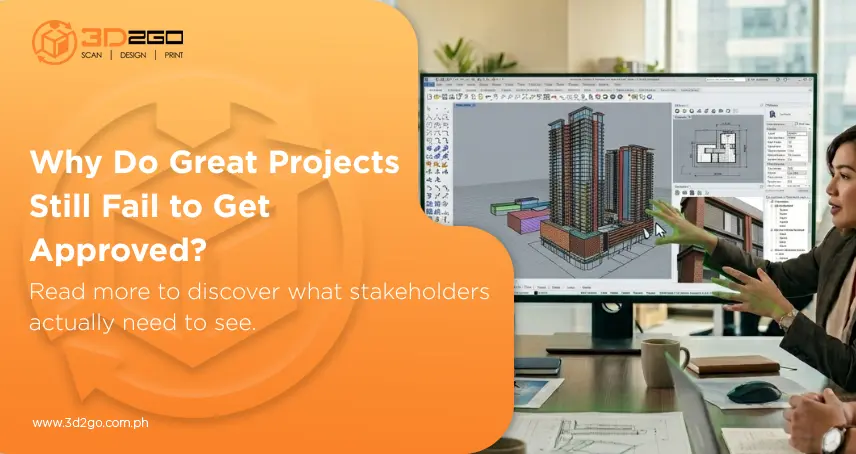
In most industries today, ideas don’t move forward unless people can actually see what they’re signing off on. And that expectation has changed how proposals are built, presented, and judged.
This is where custom 3D object modeling paired with 3D visualization rendering becomes more than a presentation tool—it becomes a decision-making asset.
Instead of asking stakeholders to interpret drawings or imagine outcomes, you’re showing them a clear, realistic version of the project long before anything is built. And that clarity often makes the difference between hesitation and approval.
Why Traditional Project Presentations Fall Short
Even well-prepared technical drawings have a limitation: they assume everyone reading them interprets them the same way.
Executives, investors, and non-technical stakeholders often don’t process blueprints the same way engineers or architects do. So what looks “clear” on paper can still feel uncertain in practice.
3D visualization rendering removes much of that ambiguity by translating technical plans into something instantly recognizable—spaces, proportions, lighting, and structure, all shown as they would appear in reality.
When Understanding Becomes the Real Bottleneck
If a stakeholder can’t confidently visualize the outcome, approval naturally takes longer. Questions increase. Revisions pile up. Discussions circle back to basics. 3D visualization rendering helps break that cycle.
By presenting a near-real representation of the project, it removes the need for interpretation. People don’t have to “figure it out”—they can already see it.
Aligning Stakeholders Faster and More Clearly
One of the most overlooked challenges in securing project buy-in is misalignment. Different departments often interpret the same proposal differently, especially when relying on technical documents alone. That leads to conflicting feedback and repeated revisions.
With 3D visualization rendering, everyone works from the same visual reference. Instead of debating what something might look like, conversations become more focused on decisions and refinements.
Why Visual Communication Now Drives Decisions
A Statista report on digital transformation trends highlights that organizations are steadily shifting toward visual tools and interactive digital formats to improve understanding and decision efficiency in complex workflows.
That trend is especially visible in development-heavy industries, where 3D visualization rendering is now often part of early-stage approvals—not just final presentations.
Reducing Uncertainty for Investors and Approvers
When investors evaluate a project, they’re not just looking at potential returns—they’re also weighing uncertainty.
3D visualization rendering helps reduce that hesitation by turning abstract plans into something tangible and easy to assess.
When stakeholders can clearly see what’s being built, it becomes easier to trust the project’s direction. That trust often plays a bigger role in approval decisions than the numbers alone.
Helping Teams Make Better Early Decisions
One of the biggest advantages of 3D visualization rendering is how early it can influence design decisions.
Before construction begins, teams can review layouts, materials, lighting, and spatial flow in a realistic context.
That makes it easier to spot issues early—before they turn into expensive changes later. Instead of reacting to problems during construction, teams can refine the design while it’s still flexible.
Making Complex Projects Easier to Present
Some projects are just difficult to explain with drawings alone. Large developments, mixed-use spaces, or intricate structural designs often require too much interpretation to support quick decision-making.
3D visualization rendering simplifies that by showing the complete experience of the finished project in a single visual flow.
It replaces technical explanation with visual understanding. That makes presentations more engaging and far more effective in securing attention from decision-makers.
Improving Communication Across Non-Technical Audiences
Not every stakeholder involved in approvals has a technical background. In many cases, decision-makers come from finance, business strategy, or operations. For them, clarity matters more than technical detail.
3D visualization rendering translates complex design intent into visuals that don’t require interpretation.
Fewer Misunderstandings, Fewer Revisions
A common reason projects get delayed is mismatched expectations.
When stakeholders imagine the project differently from how it’s designed, revisions become inevitable. 3D visualization rendering helps minimize that gap early in the process.
By showing a realistic version of the final outcome, it reduces surprises later and keeps feedback more grounded. That often results in faster approvals and fewer revision cycles overall.
From Concept to Convincing Proposal
A strong idea alone isn’t always enough to get approval. It also needs to feel real.
3D visualization rendering bridges that gap by turning abstract plans into something stakeholders can immediately connect with. When people can clearly see the outcome, decisions become easier—and faster.
Why Visualization Has Become Essential in Approvals
Project approval processes have evolved. Clear communication is no longer optional—it’s expected.
3D visualization renders that expectation by making complex ideas easier to understand, evaluate, and approve across stakeholder groups.
It strengthens the proposal without changing the core design itself.
Turning Ideas Into Approvals That Move Forward
3D2GoPH 3D visualization rendering helps teams present projects in a way that feels clear, realistic, and decision-ready from the start. Whether for early-stage concepts or final approval presentations, the goal is simple: reduce confusion and improve understanding.
If you’re preparing a project that needs stronger visual communication to secure buy-in, you can connect with us and explore how 3D visualization rendering can support your next presentation.