Top 10 Industries That Depend on High-Quality 3D CAD Models
May 27, 2026
How a 3D Laser Scanning Device Improves Precision in Manufacturing
May 29, 2026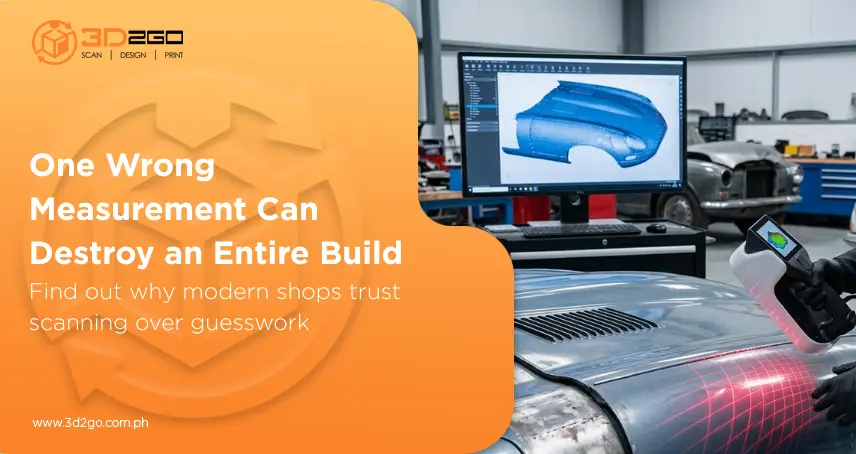
Modern vehicles aren’t just machines anymore. They’re packed with layered curves, tight tolerances, intricate body geometry, and components that need to align with remarkable precision. In that kind of environment, rough measurements and manual estimation only get you so far.
That’s exactly why 3D vehicle scanning services have become such an important part of automotive workflows today. Whether the goal is restoration, reverse engineering, custom fabrication, or digital archiving, a reliable vehicle-scanning system provides engineers and builders with something far more valuable than approximation: accurate data.
What a Vehicle Scanning System Really Does
At its core, a vehicle scanning system captures the exact physical shape of a vehicle or automotive component and converts it into digital form.
Instead of relying on hand measurements or reference photos, scanners collect thousands of precise surface points across the object. That data is then processed into a highly detailed digital model that engineers and designers can work with directly.
Curved panels, uneven contours, mounting points, and hidden surface variations that are difficult to measure manually become much easier to analyze digitally. What used to take days of measuring can now be captured with far greater consistency.
Why Manual Measuring Often Creates Problems
Traditional measuring methods still work for basic tasks, but vehicles rarely consist of simple shapes.
A car body isn’t flat. Engine bays aren’t perfectly symmetrical. Even small variations in contour can affect fitment once fabrication begins. That’s where manual measurements tend to create issues—especially when projects demand tight tolerances.
A vehicle scanning system eliminates much of that uncertainty by capturing the actual geometry instead of relying on estimates.
A few millimeters might not sound like much on paper, but in automotive fabrication, that gap can mean panels don’t align properly, aftermarket parts don’t fit cleanly, or modifications require unnecessary rework.
Automotive Restoration Depends on Precise Digital Capture
Classic vehicle restoration has become one of the biggest applications for modern scanning technology.
A lot of older vehicles simply don’t have existing CAD files or readily available replacement parts anymore. Some components haven’t been manufactured in decades. In those cases, restoration teams often need to recreate damaged or missing parts from scratch.
Using a vehicle scanning system, technicians can digitize original components and preserve exact dimensions before reproduction begins.
That process helps maintain authentic proportions, original mounting geometry, and factory-level detail that would be difficult to replicate manually.
Reverse Engineering Became Faster Because of Scanning
Reverse engineering used to involve long hours of manual measuring, documentation, and repeated verification.
Now, a vehicle scanning system can capture highly detailed geometry in a fraction of the time. Engineers can then convert that scan data into CAD models for redesign, testing, or manufacturing purposes.
This becomes especially useful when:
- Original technical drawings no longer exist
- Components need modification or upgrades
- Replacement parts must be recreated
- Compatibility testing is required
The workflow moves faster because teams spend less time guessing dimensions and more time solving actual engineering problems.
Custom Fabrication Needs Real-World Accuracy
Whether it’s a widebody kit, performance intake system, interior conversion, or custom mounting bracket, every component needs to match the vehicle accurately once installed.
A vehicle scanning system helps fabricators work directly from real-world dimensions instead of approximations. That improves fitment accuracy and reduces trial-and-error during production.
And realistically, fewer revisions mean lower costs, faster turnaround times, and cleaner final results.
Performance and Motorsport Teams Use Scanning Constantly
In performance-focused automotive environments, precision becomes even more important.
Motorsport teams regularly use vehicle-scanning system workflows to study aerodynamic surfaces, optimize component placement, and evaluate body modifications digitally before fabrication begins.
Even small adjustments can influence airflow behavior, cooling efficiency, or weight distribution. When performance margins are tight, digital accuracy becomes a competitive advantage.
Quality Control Becomes More Reliable
A vehicle scanning system allows teams to digitally compare finished parts against original specifications. That makes it easier to spot dimensional deviations, alignment issues, or production inconsistencies before components move further into the assembly process.
Catching issues early helps businesses reduce waste, avoid rework, and maintain higher production standards overall.
Automotive Industries Continue Investing in Digital Workflows
The push toward digital manufacturing continues to accelerate across the automotive sector.
According to a study, additive manufacturing in the U.S. generated an estimated $2.8 billion in goods shipments, highlighting the growing industrial reliance on advanced digital manufacturing and engineering technologies.
That shift explains why demand for vehicle scanning system services continues to grow across the restoration, engineering, manufacturing, and custom fabrication industries.
Why Scan Quality Matters More Than Most People Expect
Low-resolution scans, incomplete surface capture, or poorly processed files can create major problems once the data moves into CAD modeling or manufacturing workflows.
A professionally managed vehicle scanning system process produces cleaner geometry, more accurate dimensions, and data that’s actually practical for engineering use.
That difference shows up quickly once fabrication or design work begins. Good scan data speeds up projects. Poor scan data slows everything down.
Why Businesses Work With 3D2GoPH
Automotive scanning projects require more than just access to equipment. They require technical understanding, accurate processing workflows, and digital outputs that are genuinely usable in production environments.
3D2GoPH provides professional vehicle scanning system services for automotive digitization, reverse engineering, restoration projects, industrial applications, and custom fabrication workflows.
Their team focuses on delivering accurate scan data that supports real-world engineering and manufacturing requirements—not just visual models, but production-ready digital references businesses can actually work from.
Precision Starts With Accurate Digital Capture
Modern automotive projects rely heavily on precision from the very beginning.
Whether the goal is restoration, fabrication, redesign, or engineering analysis, a dependable vehicle scanning system provides the accurate digital foundation needed to move projects forward with confidence.
As automotive workflows continue becoming more technical and detail-driven, accurate scanning is no longer a luxury. It’s becoming part of the standard process.
For businesses seeking reliable automotive digitization services, 3D2GoPH offers scanning solutions designed for accuracy, efficiency, and real-world use.
Start your project today: 3D2GoPH