
What to Do When You Can’t Find a Replacement Spare Part
September 14, 2026
Every classic car owner knows that stomach-drop feeling when a critical component snaps. You call around local auto shops, dig through dusty salvage yards, and spend late nights scrolling through obscure forums, only to get the exact same answer everywhere you turn: they simply don’t make it anymore.
In the past, a missing part meant your project hit an indefinite standstill—forcing you to rely on sketchy homemade workarounds or pay ridiculous prices for a worn-out original that might fail in a few months anyway. Modern digital fabrication changes all of that. When original factory stock has completely dried up, producing high-precision custom 3D printed car components lets you recreate what you need without compromising on durability, fit, or safety.
Whether you’re replacing a fragile interior trim clip, an air intake duct, or a hard-to-find engine bracket, custom 3D-printed car parts ensure owning an older vehicle doesn’t mean running out of options.
The Real Headache of Keeping Older Cars on the Road
Automakers typically stop making replacement components about 10 to 15 years after a model leaves the line. Once a vehicle hits classic, vintage, or youngtimer territory, the original supply chain vanishes.
That leaves owners dealing with a few predictable headaches:
- Brittle, Sun-Baked Plastics: Dash dials, HVAC vents, clips, and handles dry out and snap after decades of heat and UV exposure.
- Wild Salvage Markups: Private sellers holding onto rare original stock know they have you over a barrel and charge absurd prices for aging parts.
- Bad Aftermarket Fit: Generic knock-off parts rarely line up cleanly with older body panels or engine bays, forcing you to modify them just to install them.
The global demand for keeping older rides running keeps climbing. According to industry data, global online sales for replacement auto parts reached $185 billion as car owners hold onto their vehicles longer and choose to refurbish rather than replace them. But when standard suppliers come up empty, digital manufacturing steps in to bridge the gap.
How 3D Printing Revives Obsolete Auto Components
Moving from dusty warehouse shelves to digital CAD files has completely transformed vehicle restoration. Instead of hoarding physical stock for decades, replacement parts can live as lightweight digital files, ready to print whenever something breaks.
Recreating Missing Pieces from Scratch
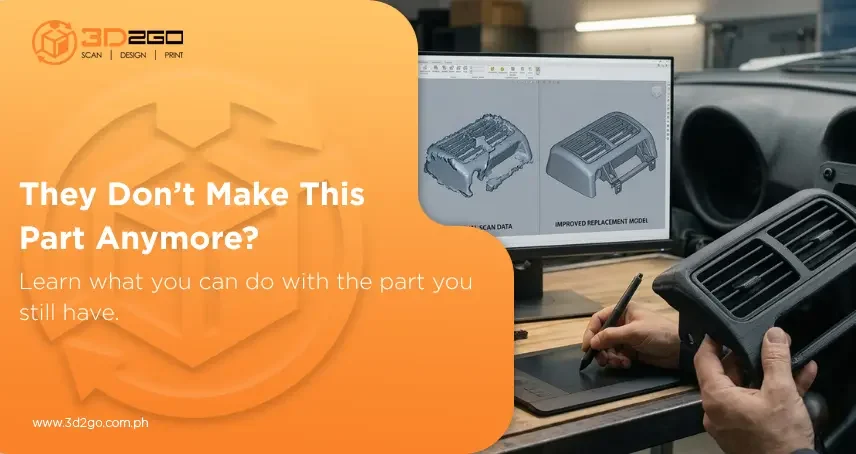
When a part breaks or wears down beyond recognition, industrial-grade 3D scanners capture its remaining physical shape down to fractions of a millimeter. Even if a piece is cracked or missing chunks, CAD technicians can digitally rebuild those lost sections before printing. Producing 3D-printed custom car parts straight from scan data eliminates tedious hand-shaping or the need to set up expensive custom tooling.
Upgrading to Modern Materials
Factory plastics from thirty years ago weren’t built to last forever. Modern 3D printing relies on engineering-grade polymers—like ABS, PETG, Nylon, and Carbon-Fiber composites—that outperform the original factory stuff. Crafting 3D-printed custom car parts from advanced filaments gives you better heat resistance, higher UV stability, and improved impact strength.
Perfecting Restomods and Custom Builds
Restoration isn’t always about keeping things 100% factory-stock. Restomod builders frequently need custom brackets, modified dash pods for modern screens, or unique interior accents. Opting for 3d printed custom car parts lets you alter mounting points, tuck away new wiring, and fit modern hardware cleanly while keeping the car’s retro vibe intact.
Popular Automotive Uses for Additive Manufacturing
Not every part under the hood faces the same physical demands, but 3D printing handles a huge range of functional and visual needs across older builds:
- Interior Trim and Dash Fixtures: Air vents, window cranks, glovebox latches, and gauge bezels snap easily after years in the sun. Printing them in heat-tolerant materials gives you a clean finish that won’t warp on warm days.
- Engine Bay Hardware: Custom intake adapters, fluid reservoir mounts, sensor brackets, and wire looms need to withstand engine heat, constant vibration, and chemical exposure.
- Lighting Enclosures and Lenses: Rare taillight housings, side marker brackets, and headlight buckets can be printed using tough clear resins or high-impact polymers that match original screw patterns perfectly.
- Gaskets and Dampeners: Hard-to-find weatherstripping clips, intake manifold dampeners, and isolated rubber mounts benefit from flexible materials that seal out moisture and absorb road vibration.
Using 3D-printed custom car parts in these areas keeps your vehicle functional without altering its original design language.
From Broken Sample to Perfect Fit
Turning a damaged component into a road-ready replacement takes a clear, practical process:
- 3D Scanning: The original or damaged piece is scanned using portable optical scanners to capture a dense 3D point cloud of its exact geometry.
- CAD Cleanup and Repair: Design engineers refine the scan data, repair cracks, and ensure all mounting points match the vehicle’s surrounding structure.
- Selecting the Material: The team picks an optimal filament or resin based on expected heat, stress, and weather exposure.
- Precision Printing: The team fabricates the component using industrial 3D printing equipment tailored to the material choice.
- Post-Processing: The team cleans up, sands, primes, or paints the finished piece so it looks like it came straight off the factory floor.
Relying on 3D-printed custom car parts throughout this workflow ensures the component drops into place smoothly on the first attempt.
Get Your Project Car Rolling Again with 3D2GoPH
An unavailable factory part shouldn’t leave a great car gathering dust in your garage or driveway. Advances in digital scanning and additive production mean you don’t have to rely on fading supply chains to keep your favorite vehicle running smoothly.
3D2GoPH can help car enthusiasts, mechanics, and restoration shops across the Philippines turn hard-to-find automotive challenges into simple digital solutions. Our team combines high-precision 3D scanning, expert CAD reverse engineering, and industrial-grade printing technology to create durable, accurate parts matched to your vehicle’s specific layout.
Don’t let a missing piece stall your build. Send us your project details today and let’s get your car back on the road with total confidence!