Why PLA Plastic 3D Printing Is Ideal for Prototypes and Display Models
May 25, 2026
Top 10 Industries That Depend on High-Quality 3D CAD Models
May 27, 2026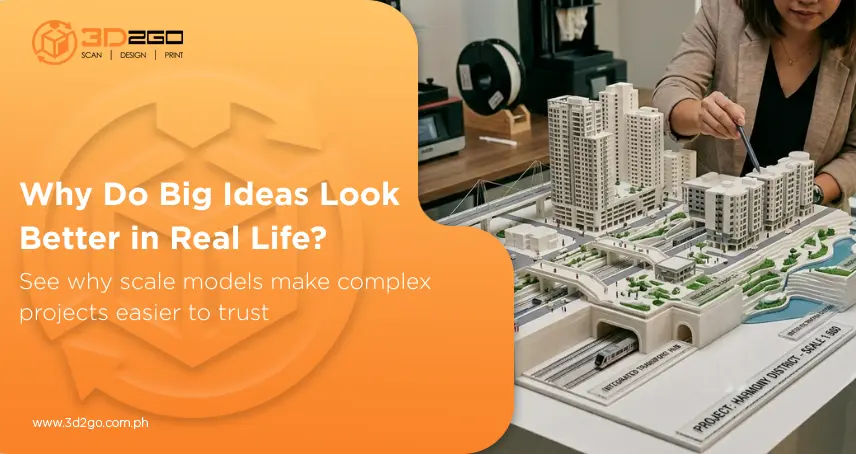
You can show someone a blueprint, a CAD file, or a polished 3D render, but there’s still a gap between seeing a design on-screen and actually understanding how it feels in physical space. That gap disappears the moment a model is sitting right in front of you.
That’s one reason architectural scale model printing continues to matter, even in an industry packed with advanced visualization software. Physical models make complex ideas easier to grasp, especially when multiple people need to review, approve, or present a project clearly.
Today, 3d printed scale models are used far beyond architecture studios. Engineers, developers, manufacturers, designers, and even marketing teams rely on them to simplify discussions, improve planning, and turn highly technical concepts into something people can instantly understand.
Why Physical Models Still Hit Differently
Digital visualization has improved dramatically over the years. Modern rendering software can produce near-photorealistic images complete with lighting, textures, and immersive walkthroughs.
Physical 3D-printed scale models give people a more intuitive understanding of proportion, spacing, and scale. You can walk around the model, look at it from different angles, naturally compare dimensions, and absorb details in a way that feels immediate.
Clients ask sharper questions. Teams notice layout concerns faster. Stakeholders understand projects without needing lengthy technical explanations. Even people with zero design background can immediately connect with a physical representation.
Architecture Still Depends Heavily on Scale Models
There’s a reason architects continue to invest in 3D-printed scale models despite having access to sophisticated visualization tools.
Buildings are spatial by nature. People need to understand how structures relate to their surroundings, how different sections interact, and how the overall design feels physically. Flat drawings can communicate measurements, but they rarely communicate presence.
Whether it’s a residential property, a commercial development, a mixed-use complex, or an urban planning proposal, models help people understand projects more naturally. Site layouts become easier to read. Elevation changes make more sense. Even the traffic flow and landscaping feel clearer when viewed in person.
That clarity becomes especially useful during:
- Client presentations
- Investor meetings
- Public consultations
- Design approvals
- Urban planning reviews
- Construction coordination
A detailed model often answers questions before they are even asked.
Engineering Teams Use Models to Catch Problems Early
The value of 3d printed scale models extends well beyond visual presentation.
Engineering firms regularly use them to evaluate layouts, mechanical assemblies, industrial systems, and production environments before implementation begins. Seeing components physically arranged together can reveal issues that may not stand out in software alone.
Clearance problems, awkward spacing, workflow limitations, accessibility concerns — these details become easier to identify when people can physically interact with the model.
Small planning mistakes discovered during construction or manufacturing tend to become expensive very quickly. Physical models help reduce that risk by making project evaluation more collaborative and easier to understand across teams.
Product Designers Benefit From Tangible Prototypes
Digital product design can only go so far before something needs to exist in the physical world.
That’s another reason 3d printed scale models are widely used during product development stages. Holding a physical version of a concept often reveals details that aren’t obvious on a monitor.
Maybe the proportions feel awkward. Maybe the product looks bulkier than expected. Maybe certain design elements don’t flow together naturally once viewed in real space.
Those insights matter because they help teams refine products earlier, when adjustments are still relatively simple and affordable.
And realistically, every successful product goes through revisions. Physical prototypes simply make those revisions smarter.
Presentations Become More Memorable With Physical Models
That’s why 3D-printed scale models are so effective in presentations, especially when explaining highly technical or large-scale projects to non-technical audiences.
Not everyone can interpret engineering drawings or architectural plans comfortably. But almost anyone can understand a physical model sitting on a conference table.
It simplifies communication immediately.
Clients can evaluate layouts faster. Stakeholders can visualize the project flow more clearly. Teams spend less time translating technical language into something easier to picture.
That efficiency often speeds up approvals because fewer misunderstandings slow conversations down.
Modern 3D Printing Changed Scale Model Production Completely
Traditional handcrafted models required enormous amounts of manual labor. Skilled artisans would spend days or even weeks cutting, assembling, and refining tiny structural components by hand.
Modern 3d printed scale models changed that process entirely.
Today, digital modeling and additive manufacturing allow businesses to produce highly detailed physical models with greater consistency and far shorter turnaround times. Intricate structures, curved geometries, and fine details that once demanded intensive craftsmanship can now be produced far more efficiently.
That doesn’t remove craftsmanship from the process — it simply shifts where precision happens.
Now, much of the complexity happens during digital preparation, file optimization, scaling, and production planning before the printer even starts running.
Businesses Are Becoming More Visualization-Driven
Companies today rely more heavily on visual communication than ever before.
According to research, manufacturers implementing advanced digital manufacturing technologies reported improvements of 10% to 20% in production output and up to 20% improvement in employee productivity.
That shift naturally increases demand for tools like 3d printed scale models, especially for projects where visual clarity directly affects decision-making.
The more complicated the project becomes, the more useful physical visualization becomes.
Scale Models Help Prevent Expensive Miscommunication
One overlooked advantage of 3d printed scale models is how effectively they reduce confusion.
Miscommunication during the planning stages can create serious downstream problems later. A misunderstood dimension, an inaccurate spacing assumption, or an overlooked structural detail can quickly delay projects and increase costs.
When architects, engineers, contractors, and clients are all reviewing the same tangible reference, conversations become more aligned. People notice issues earlier because they’re seeing the same thing physically instead of interpreting technical files differently.
In many cases, small corrections made during model reviews prevent much larger problems later during construction or manufacturing.
Quality Matters More Than People Expect
Poor print quality, inaccurate scaling, rough finishing, or weak assembly work can make a project look less polished than intended. If the model lacks precision, it can undermine confidence rather than improve it.
That’s why businesses handling important presentations often work with experienced providers for 3d printed scale models rather than rushing production internally.
Professional teams understand how to optimize files, choose appropriate materials, manage fine details, and produce models that balance durability with presentation quality. And honestly, those details show immediately once the model is sitting in front of people.
Why Businesses Work With 3D2GoPH for Scale Model Projects
Businesses seeking professional model production typically need more than just simple 3D printing support. They need accurate digital preparation, dependable execution, and models that can confidently handle presentations, planning reviews, and project discussions.
3D2GoPH provides professionally produced 3d printed scale models for architecture, engineering, industrial planning, product development, and commercial visualization projects across multiple industries.
Their team supports projects that require both technical precision and presentation-ready quality, helping businesses transform highly detailed concepts into physical models people can actually interact with and understand.
Complex Ideas Become Easier to Understand When They’re Physical
That’s exactly why 3d printed scale models continue to play such an important role across architecture, engineering, manufacturing, and development workflows today.
They make communication clearer, planning more collaborative, and complex ideas far easier to evaluate before production or construction begins.
For businesses looking to turn technical concepts into presentation-ready physical displays, 3D2GoPH provides professional scale model solutions designed for real-world planning, visualization, and project development.