A successful trade show booth, brand activation, or product launch at major Philippine venues like SMX Convention Center, World Trade Center, or Megatrade Hall demands strong visual impact. When hundreds of exhibitors compete for foot traffic across crowded aisles, standard pull-up banners, flat vinyl backdrops, and flimsy foam props often blend into the background. To capture attention, marketing teams and event agencies need physical assets with real depth, precise branding, and lasting durability.
Bringing complex three-dimensional structures to life requires a vendor that understands local fabrication, structural safety, and high-resolution finishing. Custom display printing for events gives event planners a direct path from digital CAD files to venue-ready physical props. However, choosing the right provider for custom event display printing Philippines businesses trust involves evaluating printing technology, material options, post-processing capabilities, and turnaround reliability.
What to Look for in a Philippine Event Display Fabrication Vendor
Not all print shops and prop fabricators offer the same technical setup. When evaluating potential local partners for your upcoming exhibition or pop-up, keep these critical criteria top of mind:
1. In-House End-to-End Capabilities
A full-service fabrication vendor manages every step under one roof—from initial 3D CAD digital modeling and sculpting to large-format printing, wet sanding, custom Pantone spray painting, and final assembly. Outsourcing parts of the process to third-party workshops often leads to unexpected delays, higher freight costs, and miscommunication of brand colors.
2. Range of Printing Materials
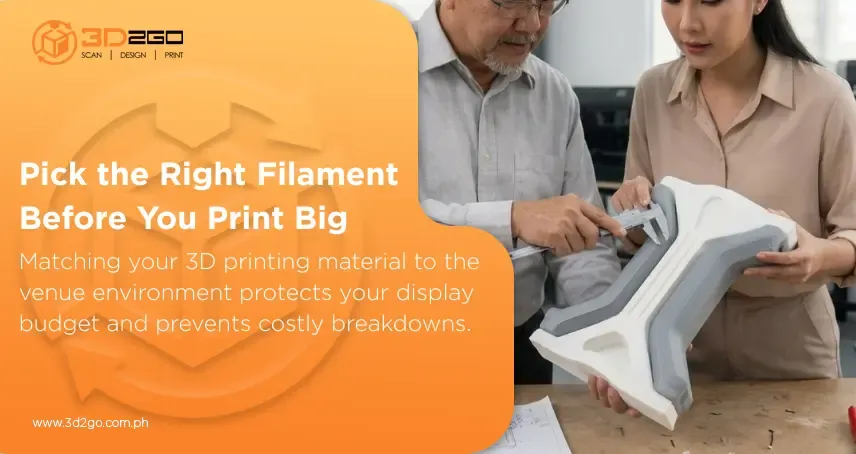
Venues in Metro Manila and regional event hubs range from air-conditioned indoor halls to humid outdoor pop-up setups. Your printing provider should offer diverse thermoplastics and resins—such as PLA bioplastics for crisp indoor props, heat-resistant ABS for structural frameworks, PETG for weather-exposed activations, and photopolymer resins for micro-detailed showcase pieces.
3. Scale and Modular Printing Expertise
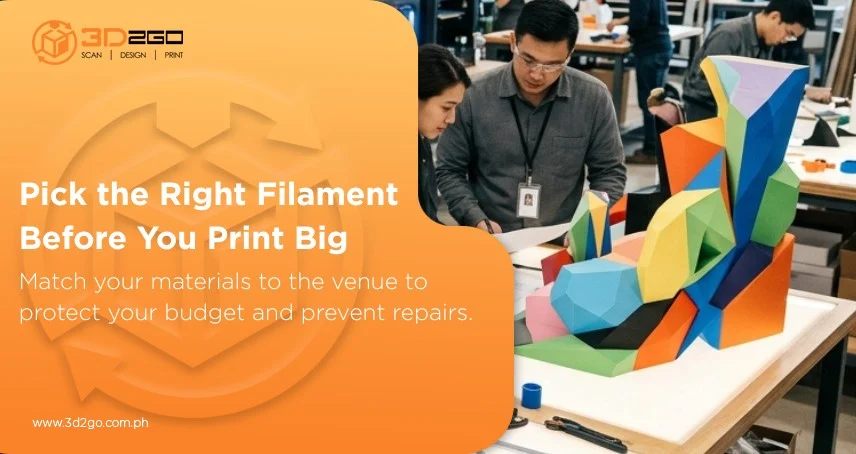
Large event props rarely fit on a standard 3D printer bed in a single piece. An experienced vendor knows how to slice oversized designs digitally into interlocking modular sections. They build hidden alignment pins, internal support ribs, and weighted bases so pieces pack easily into transit cases and assemble quickly on setup night.
4. Color Precision and Hand-Finishing Quality
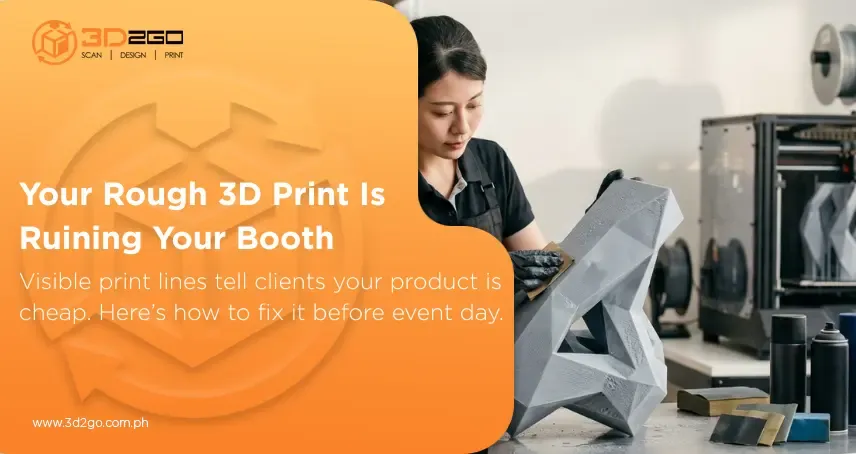
Straight off the printer, raw plastic exhibits subtle layer ridges. High-end providers specialize in progressive wet sanding, high-build automotive priming, and precise Pantone spray painting to ensure your props match your corporate brand guidelines perfectly under harsh convention lighting.
Evaluating these core services helps you choose a custom event display printing Philippines provider that can deliver polished, venue-ready assets.
Why Modern Brands Are Upgrading from Wood and Foam Props
Traditional commercial prop making in the Philippines relied heavily on manual wood carving, hand-cut Styrofoam, and basic sheet metal work. While those methods served a purpose in the past, they pose significant operational risks for fast-paced marketing campaigns.
Research shows that up to 48% of trade show exhibitors confirm eye-catching, high-impact physical displays are the single most effective strategy for drawing foot traffic into an exhibition booth. Relying on fragile, outdated props can undermine that visual draw:
- Fragile and One-and-Done: Hand-carved Styrofoam props chip, dent, and absorb moisture easily during transit between Metro Manila venues and provincial tours, often forcing teams to discard them after a single weekend.
- Lack of Consistency: When running simultaneous brand activations across Luzon, Visayas, and Mindanao, hand-carved props rarely match each other accurately.
- Labor-Intensive Organic Shapes: Sculpting complex curves or detailed product replicas by hand requires extensive manual labor, inflating your production budget without guaranteeing structural balance.
Switching to custom event display printing specialists in the Philippines solves these operational pain points. Computer-guided additive manufacturing uses digital CAD files to build lightweight, impact-resistant, mathematically precise physical pieces that withstand repeated packing and setup during events.
4 Common Display Assets Made via 3D Printing
Modern 3D fabrication allows creative directors and visual merchandisers to build custom booth fixtures that pull visitors in:
1. Oversized Product Scale Models
Launching a new packaged good, tech gadget, or industrial component? Printing a scaled-up, hyper-detailed product replica creates an instant centerpiece. Visitors can inspect fine textures, buttons, and design details that would be hard to see on a small handheld item.
2. Dimensional Corporate Logos and Emblems
Flat wall stickers and vinyl cutouts lack the authority of thick, 3D-sculpted logos. Selecting custom event display printing Philippines allows you to produce floating emblems, backlit wall letters, and custom crests that look crisp in photo ops and livestream broadcasts.
3. Custom Product Docking Stations
Standard display tables rarely fit specialized hardware or electronics neatly. Custom 3D-printed mounting docks, cable-managed display stands, and ergonomic holders fit your gear like a glove while keeping power cords hidden out of sight.
4. Stage Decor and Award Trophies
For corporate galas, partner summits, and awards nights, custom 3D-printed pedestal stands, custom trophies, and themed stage centerpieces add a refined, premium feel to corporate setups.
Relying on custom event display printing Philippines ensures every piece across your venue looks clean, professional, and built to last.
Old-School Props vs. 3D Printed Displays
| Feature | Hand-Carved Foam & Wood Props | 3D Printed Event Displays |
| Accuracy | Dependent on manual carving skill | Computer-guided millimeter precision |
| Design Options | Hard to execute complex organic curves | Unlimited geometric shapes & hollows |
| Durability | Fragile; dents and chips easily | Impact-resistant bioplastics & thermoplastics |
| Reusability | Typically single-use | Reusable across multi-city campaign tours |
| Replicability | Hard to reproduce identical twins | Exact duplicate prints from digital CAD files |
Investing in custom event display printing Philippines suppliers gives your marketing team reusable assets that maintain visual consistency across every campaign stop.
Practical Questions to Ask Your Print Provider Before Ordering
To avoid surprise delays or unexpected costs on setup day, ask your fabrication partner these key operational questions before signing a contract:
- Do you manage digital 3D CAD modeling in-house?
If you don’t have a print-ready 3D file, your provider should be able to create or optimize a digital CAD model from 2D vector logos, reference photos, or dimensional sketches. - How do you prepare the surface for custom brand colors?
Confirm that the team performs wet sanding, high-build priming, and Pantone-matched spray painting rather than applying basic brush paint over raw plastic layers. - How will large displays be packed and transported?
Ensure large props are split digitally into modular, interlocking sections with internal alignment pins and weighted bases so they pack into standard crates without breaking.
Asking these practical questions ensures your chosen custom event display printing Philippines team delivers sturdy, venue-ready props on schedule.
Build High-Impact Event Displays with 3D2GoPH
Your trade show booth and event props serve as the physical handshake between your brand and prospective clients. Settling for flat banners, flimsy foam carvings, or unfinished plastic prints can distract visitors and weaken your overall marketing message.
3D2GoPH helps marketing managers, event agencies, and business owners turn bold design ideas into durable, venue-ready realities. As the premier full-service 3D technology provider in the Philippines, we handle every stage of production under one roof—from initial 3D CAD modeling and digital sculpting to high-resolution printing, wet sanding, gap filling, custom Pantone spray painting, and protective top-coating. Whether you need a giant product model, a backlit logo, or a complete suite of custom event display printing Philippines clients rely on our team to deliver sturdy, detailed structures built to stand out in high-foot-traffic halls.
Don’t let flat banners compromise your brand presentation. Contact our team today to start building your custom, venue-ready event displays!
Frequently Asked Questions
How long does custom event display printing take in the Philippines?
Production timelines depend on prop size and design detail. Simple product stands or small dimensional logos usually take 3 to 5 business days, while large, multi-piece booth displays or bulk event orders require more time for CAD modeling, printing, sanding, and spray painting.
Do I need a print-ready 3D CAD file to get a quote?
No. You don’t need technical CAD experience. You can provide basic reference photos, 2D vector logos, or dimensional sketches, and our team will build the digital 3D model for your approval before printing starts.
Are 3D-printed displays durable enough to reuse across multiple events?
Yes. Unlike fragile foam props, custom event display printing Philippines experts produce uses tough thermoplastics like PLA, ABS, or PETG. Sealed with clear protective topcoats, these pieces handle repeated packing, shipping, and venue setup without losing their finish.
Can 3D-printed displays be painted in exact corporate brand colors?
Yes. After printing, displays undergo wet sanding, priming, and spray painting matched to exact corporate Pantone or RAL color codes in glossy, matte, metallic, or textured finishes.
Key Takeaways
- Prioritize End-to-End In-House Support: Choose vendors that manage CAD modeling, printing, wet sanding, and Pantone painting under one roof to prevent delays and quality drops.
- Match Materials to Venue Environment: Use PLA bioplastics for indoor exhibition halls; opt for PETG or ABS thermoplastics for outdoor pop-ups exposed to heat and weather.
- Smart Modular Slicing: Design oversized props with interlocking joints and internal lattice infill to keep pieces lightweight, sturdy, and easy to ship.
- Reusable Brand Investment: 3D-printed event displays offer millimeter-exact precision and long-term durability, making them much more cost-effective than disposable foam props over multiple campaign stops.