Finding a replacement car part sounds simple until the part has been discontinued, imported, or made for an older model.
You might search online, call different suppliers, or check repair shops—only to find nothing that matches.
That’s where custom 3D printed parts can offer another option. If you still have the original component, you may be able to use it as a reference for creating a replacement.
This is where 3D printed auto parts can help with hard-to-find components, prototypes, and certain non-safety-critical automotive applications.
Why Are Some Car Parts So Hard to Find?
Older models eventually leave production, suppliers stop making certain components, and replacement parts can become difficult to source. Even when you find one, shipping or minimum order requirements can make the search more frustrating than expected.
Some parts are also specific to a particular model or production year.
A small plastic cover, bracket, clip, knob, or interior component might seem insignificant—but when it breaks, finding an exact replacement can become a headache.
That’s one reason people look into 3d printed auto parts as an alternative to searching for an increasingly rare original.
What Can Actually Be 3D Printed for a Car?
Parts that handle extreme heat, high pressure, heavy loads, or critical safety functions require materials and manufacturing methods designed for those conditions.
But many smaller components can be candidates for 3D printing, particularly when the goal is to recreate a specific shape.
Examples can include:
- Interior trim pieces
- Switch covers
- Dashboard accessories
- Mounting brackets
- Cable guides
- Clips and holders
- Custom organizers
- Prototype components
The exact application depends on the part, its material requirements, and how it will be used.
What If You Still Have the Broken Part?
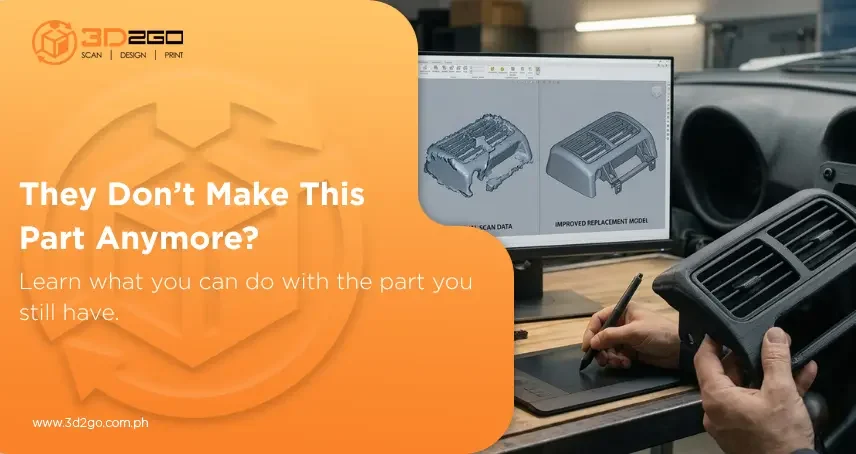
You don’t necessarily need the original CAD file to recreate a physical component. The existing part can serve as the reference.
A scanner can capture its shape and dimensions, creating digital data that can then be cleaned up and converted into a model suitable for further work.
This can be particularly useful for older vehicles. Instead of searching endlessly for an original replacement, the existing component can become the starting point for a new design.
Can a Broken Part Become a New Digital Model?
Yes, depending on its condition and geometry. You can scan the physical component to capture its shape. You can then use the resulting data to create or refine a digital model.
If the original part has a broken section, the model may need additional design work to recreate the missing geometry.
This process also opens the door to small improvements. Maybe the original bracket was difficult to install. Maybe a mounting point needs a slight adjustment. Maybe you want to make a replacement that fits a modified setup.
Instead of blindly copying the original, you can use it as a starting point for a better-fitting design.
Why Is This Useful for Older Cars?
Older vehicles often have a frustrating problem: the car still works, but one small part doesn’t. The engine may be fine. The transmission may be fine. The interior may be in good condition.
Then a tiny plastic component breaks, and suddenly you’re hunting through forums and second-hand listings for something that hasn’t been manufactured in years.
3d printed auto parts can help fill that gap for suitable components. Rather than waiting for a rare replacement to appear, you can explore whether the part can be digitally recreated and produced based on the original.
A quick but important note
3D printing isn’t a universal replacement for factory-made automotive parts.
Brake components, steering parts, suspension components, structural pieces, and other safety-critical parts need appropriate engineering validation and materials. A printed replacement should never be assumed safe simply because it fits.
For smaller, non-critical components, however, the possibilities are much broader.
From a Broken Part to a New One
Once the original part has been scanned or measured, the next step is creating a digital model.
You can adjust that model before printing. If a clip needs to be stronger or a bracket needs a small change, you can make those changes before producing the final piece.
That’s where 3d printed auto parts can be useful. You aren’t simply copying an old part—you can create a replacement that fits the job you’re trying to solve.
3D Printing Is Already Used in Automotive Work
3D printing isn’t just for hobbyists. Automotive companies already use it for prototypes, tools, and certain parts.
Deloitte’s 2025 automotive research found that automotive companies surveyed consider cutting non-value-added work very or critically important. The report also highlights an automotive company using 3D printing to produce multiple designs and prototypes without molds, helping reduce lead times, waste, and costs.
That same idea can help with hard-to-find car parts. Instead of keeping a physical replacement in stock, you can digitally model a suitable part and produce it when needed.
What Happens Before You Print?
A good replacement starts with a good model.
The part needs to be checked for:
- Correct measurements
- Mounting points
- Wall thickness
- Fit and clearances
- Material requirements
- How the part will be used
This matters because 3d printed auto parts aren’t automatically suitable just because the shape looks right. A part that holds a cable is very different from one that sits near an engine or carries a mechanical load.
Can You Improve the Original Part?
If the original design had a weak clip, awkward mounting point, or unnecessary material, the digital model can potentially be adjusted.
You can also create a modified version for a custom build or restoration project.
That’s one of the biggest advantages of 3d printed auto parts: the digital file can become the starting point for future changes instead of a one-time replacement.
What About Cost and Production?
For a common component that’s still readily available, buying the original replacement will usually make more sense.
But for a discontinued part that takes weeks to locate—or a one-off component that nobody sells—custom production can be worth considering.
You also don’t necessarily need to produce hundreds of pieces. One replacement may be enough.
That’s where 3d printed auto parts can make sense for restorations, prototypes, custom builds, and small-batch needs.
A Better Option When the Original Is Hard to Find
3D printing can’t replace every automotive part, but it can offer a practical option for suitable, non-critical components that are no longer available.
A physical part can serve as the reference for a digital model, which can then be adjusted and printed as a replacement.
3D2GoPH can help recreate suitable automotive components through custom 3D printing.
Can’t find the part you need? Send us the details and see if it can be recreated.