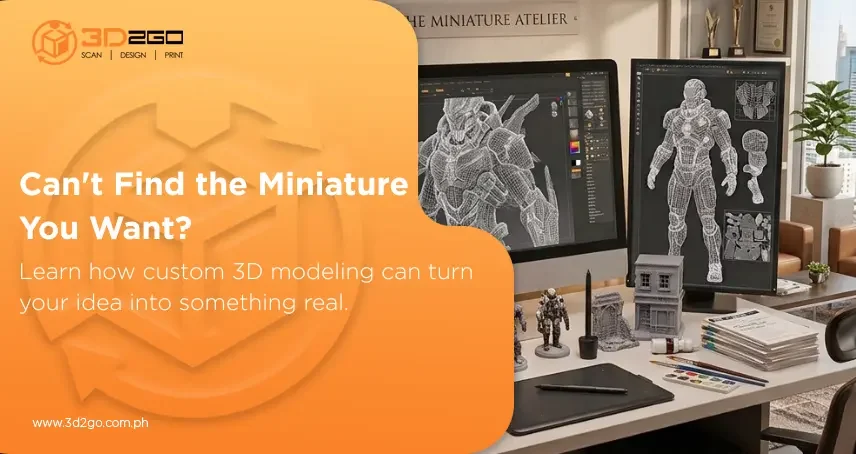
Finding the right miniature isn’t always easy. Maybe the character you want doesn’t have an official figure. Maybe you need a specific building for a diorama. Or maybe you have an idea you can’t find anywhere.
With custom 3D design, you don’t have to work around what’s already available. You can start with your own concept and turn it into a digital model ready for 3D printing.
That’s where 3d modelling miniature comes in. It gives collectors, hobbyists, designers, and businesses a way to create figures and scale models around a specific idea.
What Can You Make?
The answer depends mostly on your design. You can create characters, buildings, vehicles, animals, props, architectural pieces, and even entire miniature scenes.
Some common projects include:
- Character figures
- Collectible models
- Architectural miniatures
- Vehicles
- Diorama pieces
- Fantasy characters
- Game figures
- Custom decorations
The point isn’t simply to make something smaller. It’s to create a miniature that matches the original idea as closely as possible.
Custom Character Figures
Ever wanted a figure of a character that doesn’t have an official collectible? A custom model can help fill that gap.
With 3d modelling miniature, you can work from reference images, sketches, or your own concept. Details such as clothing, facial features, accessories, and poses can all become part of the design.
You can also create an original character from scratch rather than copying an existing one. For collectors, that opens up options that simply aren’t available from regular retail figures.
Miniature Buildings and Scale Models
Miniature modeling also works well for buildings. Architects, students, property developers, and hobbyists can create scaled versions of houses, commercial buildings, landmarks, and other structures.
A 3D modeling miniature can show a building’s shape and proportions in a way a flat drawing can’t. You can also use the model as part of an architectural presentation, scale model, or display.
Building a Better Diorama
A street scene might need buildings, vehicles, people, signs, furniture, and other small objects. If one piece looks noticeably different in scale, the entire scene can feel off. That’s where 3d modelling miniature becomes useful.
Each piece can follow the same scale and visual style, helping everything fit together naturally. You can also create pieces specifically for the space you have instead of searching for ready-made models that may not fit.
Why Does Scale Matter So Much?
A detail that’s easy to see on a full-size object might disappear when you shrink it. A thin component might become too fragile to print. Small gaps may close up completely.
A good 3d modelling miniature balances detail with what the final printed piece can realistically handle.
That might mean slightly changing a feature, thickening a small part, or simplifying a detail without losing the overall look.
Turning Digital Designs Into Physical Models
The digital model comes first. Once it’s ready, you can print it and add finishing touches like sanding, painting, or assembly.
Research found that more than 70% of surveyed manufacturers had adopted technologies like data analytics and cloud computing, with many also investing in 3D modeling and 3D scanning.
For miniatures, this means you can refine the design digitally before turning it into a physical model.
Collectibles Made Around Your Idea
Mass-produced figures have one obvious limitation: you get to choose from what already exists. You could create a particular pose, an alternate costume, an original character, or a figure based on your own design.
A 3d modelling miniature can also become part of a collection built around a theme that’s difficult to find commercially. For collectors who want something different, that flexibility can be the biggest advantage.
Miniatures for Games and Creative Projects
Tabletop games and role-playing games often need characters, monsters, vehicles, buildings, and other pieces.
Custom 3d modelling miniature work lets you create pieces around your actual game or story rather than trying to make an existing figure fit. It can also work for personal creative projects, prototypes, displays, and concept pieces.
What Makes a Miniature Worth Printing?
Will it sit on a shelf? Will people handle it regularly? Does it need to fit inside a diorama? Will you paint it?
The size, material, level of detail, and structure all matter. A display piece may need delicate details, while a frequently handled model may need stronger parts.
Good 3d modelling miniature work considers the final use before the printer starts running.
When Does Custom Modeling Make Sense?
If you can easily find the miniature you want, buying one may be the simpler option. Custom modeling becomes more useful when the exact piece doesn’t exist or doesn’t quite match what you need.
Maybe you have an unusual character design. Maybe you’re recreating a specific building. Or maybe you simply want a collectible that nobody else has.
In those cases, 3d modelling miniature gives you a starting point based on your own idea instead of someone else’s catalog.
Make the Miniature Yours
The best part of custom modeling is having control over the design. You decide what the miniature represents, how it looks, how large it should be, and what details matter most.
3D2GoPH can help turn your concept, reference images, or existing design into a detailed digital model ready for 3D printing.
Have a miniature in mind? Start turning your idea into a model you can actually hold.