
Top 10 Benefits of Converting a Laser Scan to 3D Model
April 15, 2026
3D Printed Body Parts: The Future of Medical Customization
April 17, 2026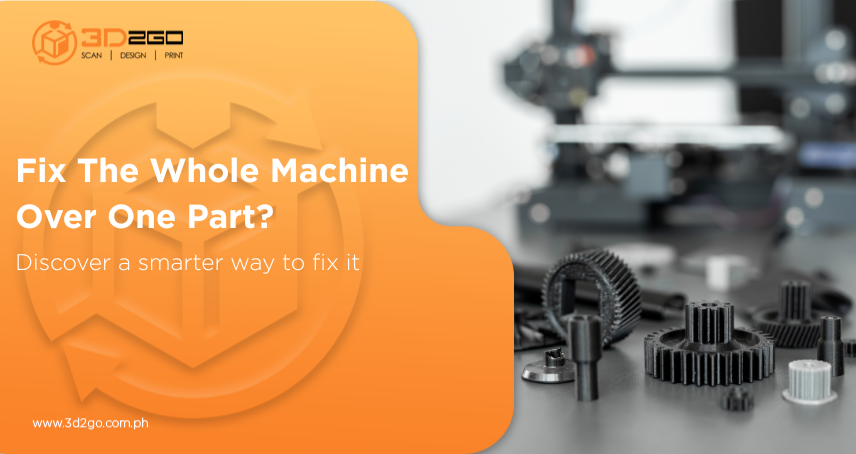
A machine slows down, makes an odd noise, or stops working altogether. After a quick check, the issue turns out to be a single worn-out component. Easy fix, until you realize that part is no longer available.
That’s when most businesses face an uncomfortable choice: spend heavily on a full replacement or try to make do with temporary fixes.
This is where custom printed components come into play. Instead of chasing unavailable parts, companies are turning to options like recreating exactly what they need. And more often than not, 3D-printed replacement parts are the most practical way forward.
When One Missing Part Becomes a Bigger Problem
Machines don’t fail all at once. More often, it’s one small piece that brings everything to a halt.
A cracked housing. A worn gear. A bracket that can’t hold up anymore.
Individually, these are minor issues. But when replacements aren’t available, they turn into major disruptions.
That’s the real value of 3d printed replacement parts: they focus on the specific failure point. Instead of replacing an entire system, you fix exactly what’s broken.
Why “Discontinued” Doesn’t Have to Mean “Done”
Manufacturers move on. Product lines change. Parts get phased out.
But the machines themselves? Many of them still have years of usable life left.
Relying solely on original suppliers creates a bottleneck. Once support ends, so does your access to parts.
With 3d printed replacement parts, that dependency fades. As long as there’s a reference, whether it’s a damaged component, a drawing, or a scan, the part can be recreated.
That shift puts control back in your hands.
Fixing What Matters Instead of Replacing Everything
Replacing a full system because of one failed component rarely makes sense.
It’s expensive, time-consuming, and often unnecessary.
3d printed replacement parts offer a more focused approach. You address the exact issue without disturbing the rest of the machine.
It’s a straightforward idea, but it changes how maintenance is handled. Less waste, fewer disruptions, and a clearer path to getting operations back on track.
Getting the Fit Right the First Time
A replacement part isn’t useful unless it works exactly as intended.
Even slight variations in size or structure can lead to misalignment or performance issues. That’s why precision matters.
Well-produced 3d printed replacement parts are built to match the original as closely as possible. Whether it’s reverse-engineered or modeled from scratch, the goal is the same: a part that fits without forcing adjustments.
Because the last thing you want is to fix one problem and create another.
Speed That Actually Makes a Difference
Time is usually the biggest pressure point.
Waiting weeks for a rare part, or worse, not knowing if it will ever arrive, can stall operations indefinitely.
With 3d printed replacement parts, once the design is ready, production can begin immediately. There’s no need to wait on long supply chains or outdated inventory systems.
That shorter turnaround can be the difference between a brief delay and a prolonged shutdown.
Adapting to Different Machines and Needs
Not all machines are built the same, and neither are their components.
That’s where flexibility becomes important.
3d printed replacement parts can be adapted to different specifications, whether it’s a simple support piece or a more detailed mechanical component. The process isn’t locked into standard molds or fixed production lines.
It adjusts based on the situation.
Making Existing Equipment Last Longer
There’s still a lot of value in older equipment if it can keep running.
One of the biggest advantages of using 3d printed replacement parts is extending that lifespan. Instead of retiring machines early due to unavailable parts, businesses can keep them operational for longer.
That’s not just practical, it’s cost-efficient.
According to Statista, the global 3D printing market continues to grow as industries adopt more flexible production methods. This reflects a broader shift toward maintaining and optimizing existing assets rather than replacing them outright.
Less Reliance on Unpredictable Supply Chains
Supply chains can be unpredictable, especially for older or specialized components.
Delays, shortages, and discontinuities can disrupt even well-planned operations.
By using 3d printed replacement parts, businesses reduce that dependency. Parts can be produced based on immediate needs rather than external availability.
That level of control adds a layer of stability that traditional sourcing can’t always provide.
A More Practical Way to Handle Repairs
Repairs don’t have to mean overhauls.
Sometimes, it’s simply about solving the right problem.
3D-printed replacement parts support a more precise approach to maintenance, one that focuses on fixing what’s actually broken rather than replacing what still works.
It’s a shift in mindset, but it leads to more efficient outcomes.
Why This Approach Is Gaining Ground
As more businesses deal with aging equipment and limited part availability, traditional repair methods become increasingly restrictive.
They’re slower, more expensive, and often less reliable.
That’s why 3d printed replacement parts are becoming a practical alternative. They offer a way to stay operational without overcommitting resources or waiting on uncertain timelines.
Keep What Works, Replace What Doesn’t
Most machines don’t need to be replaced; they just need the right part to keep going.
And when that part is no longer available, 3d printed replacement parts provide a way to move forward without starting over.
They bring precision, flexibility, and speed into a process that used to depend heavily on availability and timing.
Restore Function Without Overcomplicating the Process
There’s no need to rebuild everything when only one part has failed.
A well-made replacement can bring a machine back to life without unnecessary cost or disruption.
That’s exactly what 3d printed replacement parts are designed to do.
3D2GoPH focuses on creating components that are built to match real-world use, not just approximate it. The goal is simple: help businesses keep their systems running with reliable, well-fitted parts.