
From Sketch to 3D Reality: Why You Should Convert 2D Drawings with Expert Services
February 24, 2026
Why Rapid Throwaway Prototyping Is Popular Among Philippine Engineering Students
February 26, 2026
Walk into any warehouse, and you’ll see movement, forklifts weaving through aisles, pallets stacked tight, teams working against the clock. On paper, everything looks organized. In reality? Small inefficiencies hide in plain sight.
That’s where warehouse 3D scanning comes in.
A professional warehouse scan captures your facility exactly as it exists today, not how it looked five years ago on a faded CAD file. It creates a detailed digital twin of your space, giving you something far more powerful than measurements: clarity. And in logistics, clarity is leverage.
When “Good Enough” Layouts Start Costing You
Warehouses evolve. Racks get added. Equipment gets relocated. Temporary fixes become permanent solutions. Over time, what once worked starts slowing things down.
You might notice it in subtle ways:
- Picking routes that feel longer than they should
- Storage zones that aren’t fully utilized
- Tight turning spaces that increase safety risks
- Expansion plans that seem harder than expected
The problem isn’t effort, it’s visibility. Without accurate facility data, decisions are built on assumptions. A precise warehouse scan replaces those assumptions with real numbers and real geometry.
What a Warehouse Scan Actually Gives You
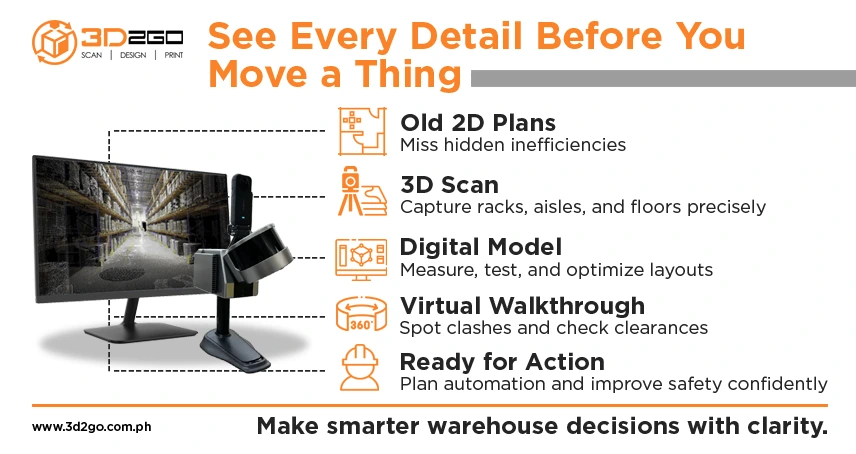
A professional warehouse scan uses laser-based technology to capture millions of spatial data points. The result is a high-resolution 3D model of your facility, down to column placements, rack dimensions, ceiling heights, and aisle widths.
This isn’t just a 3D picture. It’s measurable. Scalable. Actionable.
You can:
- Check clearances without stepping on-site
- Validate equipment fit before installation
- Analyze traffic flow digitally
- Share a single reference model across teams
Instead of walking the warehouse with a tape measure, you’re navigating a fully accurate digital environment. And that changes how decisions get made.
The Productivity Link Most Facilities Overlook
Space affects speed. Speed affects output.
A warehouse scan plays directly into that equation. When your facility model is accurate, layout adjustments become strategic instead of reactive. You’re not guessing where to move racks, you’re testing configurations before anyone lifts a pallet.
Before You Reconfigure Anything, See It First
Here’s where most facility upgrades go sideways: changes are made physically before they’re validated digitally.
That’s expensive.
A detailed warehouse scan allows teams to simulate:
- Rack reconfigurations
- Mezzanine additions
- Automation system placements
- Conveyor expansions
You see conflicts before they become costly rework. You catch spacing issues before installation day. You identify bottlenecks before peak season exposes them; it’s planning with foresight, not hindsight.
Safer Facilities Start with Better Data
Safety compliance isn’t optional, but accurate documentation often is. And that’s where problems creep in.
Clearances between racks, fire exit access, and equipment spacing; these details matter. An outdated drawing won’t show that an aisle narrowed slightly after a rack adjustment last year.
A current warehouse scan documents conditions as they truly are. That means:
- Verified aisle widths
- Confirmed exit pathways
- Accurate structural positioning
- Reduced risk exposure
When compliance reviews or internal audits come up, you’re not scrambling for updated measurements.
Planning for Growth Without Guesswork
Expansion sounds exciting until structural surprises slow everything down.
Installing new racking systems, adding automation, or upgrading equipment all require precision. A detailed warehouse scan provides engineers and planners with reliable spatial context before designs are finalized.
Instead of redesigning mid-project, teams work from verified geometry. That reduces delays, avoids costly rework, and keeps timelines intact. Growth becomes controlled, not chaotic.
A Shared Source of Truth
Warehouse planning involves operations managers, engineers, safety officers, contractors, and sometimes third-party consultants. When everyone relies on different drawings, coordination breaks down fast.
A centralized warehouse scan eliminates that disconnect. Everyone references the same digital model. Measurements match. Visualizations align. Approvals move faster. It’s not just about data accuracy; it’s about organizational alignment.
Why the Quality of the Scan Matters
Not all scans are created equal.
Low-resolution captures or poorly processed models can create more confusion than clarity. A professionally executed warehouse scan ensures:
- High-detail spatial accuracy
- Clean, usable 3D files
- Compatibility with design and BIM software
- Efficient project turnaround
When decisions involve structural modifications or automation investments, precision isn’t optional.
The Strategic Case for Acting Now
If your warehouse hasn’t been digitally documented for years, chances are it no longer matches the original plans. And if you’re considering expansion, automation, or layout optimization, working without current data increases risk.
A professional warehouse scan gives you control over space, workflow, safety, and future growth.
It turns your facility from a physical constraint into a strategic asset.
See Your Warehouse Differently
3D2GoPH approaches every warehouse scan with one goal: deliver accurate, actionable facility intelligence you can actually use.
Whether you’re optimizing layout efficiency, preparing for expansion, or validating equipment installation, precise spatial data makes every next step smarter.
If you’re ready to move beyond outdated drawings and start planning with clarity, let’s talk.