

Mind-Blowing Applications of Digital Scanning Services in Modern Industries
March 30, 2026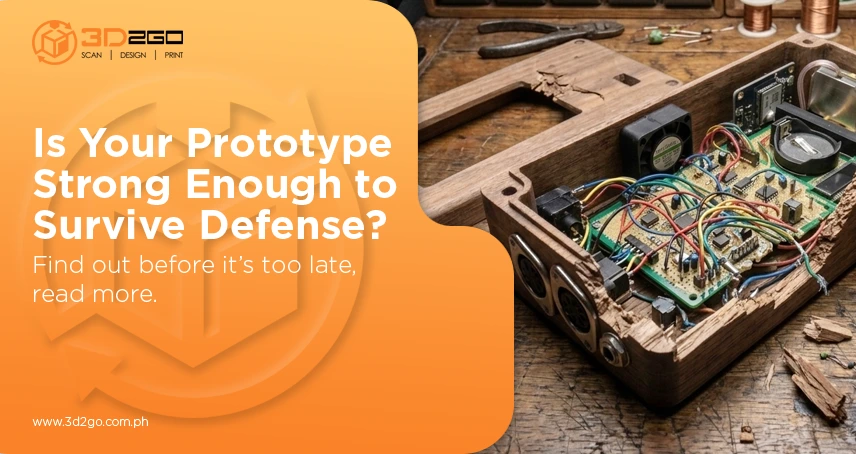
You spend weeks refining your thesis idea. Everything looks solid on paper. The logic flows, the concept feels strong, and you’re confident heading into development.
Then you try to build it.
That’s where things start to unravel. Designs don’t behave the way you imagined. Materials don’t cooperate. Deadlines creep in faster than expected. Suddenly, what felt like a strong project turns into a race just to make something work.
This is exactly why research prototype development becomes such a critical turning point. It’s not just about building a model, it’s about proving your idea holds up in the real world.
And when it comes to hardware prototyping for a thesis, that pressure is even higher. Your prototype isn’t just a requirement; it’s your evidence. It’s what your panel will question, test, and judge.
Let’s walk through where most students struggle, and how to handle it without burning time, money, or momentum.
What Hardware Prototyping for Thesis Really Involves
At a glance, it sounds simple: build a physical version of your idea.
But in practice, hardware prototyping for thesis means dealing with real-world constraints, dimensions, materials, tolerances, and functionality. You’re no longer explaining your concept. You’re proving it works.
That shift changes everything.
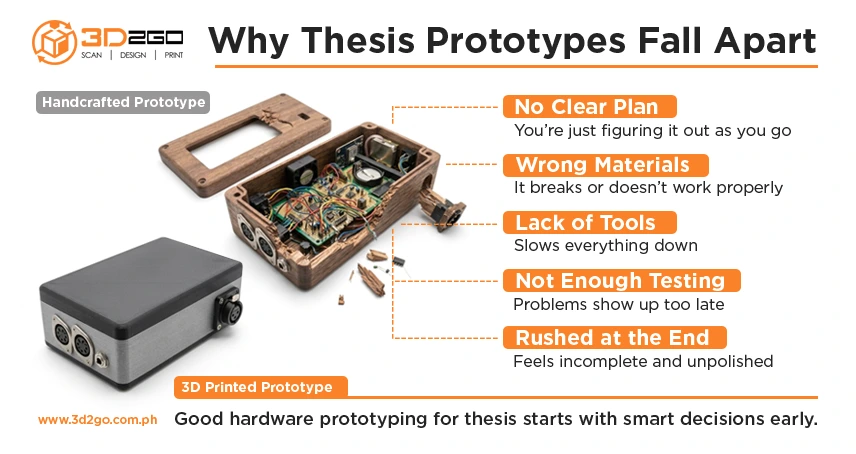
A design that looks clean in a diagram can quickly become complicated once you try to assemble it. Parts don’t align. Components interfere. And suddenly, your “simple build” needs multiple revisions just to function properly.
Why This Stage Can Make or Break Your Defense
Panels don’t just listen, they evaluate.
A working prototype makes your explanation easier to follow. It builds trust. It shows that your idea isn’t just theoretical.
But if your prototype looks rushed or fails during demonstration, it creates doubt—even if your concept is strong.
That’s why hardware prototyping for thesis often becomes the deciding factor. It’s not just about finishing, it’s about delivering something convincing.
Top 10 Challenges Students Face in Hardware Prototyping for Thesis
1. From Concept to Reality Isn’t Linear
Ideas rarely translate cleanly into physical builds. Expect friction and many adjustments.
2. Budget Runs Out Faster Than Expected
Materials, revisions, and tools add up. Cutting corners usually costs more in the long run.
3. Skill Gaps Slow Everything Down
CAD modeling, electronics, fabrication—most students are learning these on the fly.
4. Material Choices Can Backfire
Pick the wrong material, and you’re rebuilding. Too weak, too heavy, too expensive, it all matters.
5. Time Always Feels Too Short
Iteration takes time. And most students underestimate how many versions they’ll need.
6. Limited Access to Proper Equipment
Without the right tools, hardware prototyping for a thesis becomes harder than it should be.
7. Small Design Errors Become Big Problems
A minor miscalculation can force a complete redesign.
8. Testing Is Often Overlooked
A prototype that “looks done” isn’t enough; it has to work consistently.
9. Integration Issues Between Components
Getting everything to function together is often more complex than building each part.
10. Weak Presentation Undermines the Work
Even a functional prototype can fall flat if it’s poorly explained or demonstrated.
What Actually Helps You Get It Right
If there’s one pattern among successful projects, it’s this: they don’t rush into building.
Start with a clear design. Sketch it out. Model it digitally if you can. The more problems you catch early, the fewer you’ll deal with later.
Be deliberate with materials. Don’t just use what’s available, use what fits the function.
And give yourself room to iterate. Your first version won’t be perfect. That’s normal. What matters is how quickly you improve it.
Strong hardware prototyping for thesis is less about perfection and more about controlled progress.
Tools That Make the Process Easier
You don’t need everything, but the right tools make a noticeable difference.
- 3D Printing helps you create accurate parts quickly
- CAD Software lets you test designs before building
- 3D Scanning is useful for modifying existing objects
- Manual Fabrication still works for early-stage concepts
The goal isn’t to use everything; it’s to use what solves your specific problem.
A Practical Workflow That Saves Time
Many issues arise from jumping straight into fabrication. A better approach looks like this:
- Define your concept clearly
- Build a digital version first
- Create an initial prototype
- Test and identify weaknesses
- Refine before final presentation
This approach keeps your hardware prototyping for thesis focused and efficient, instead of reactive and rushed.
Why This Skill Matters Beyond Your Thesis
What you’re doing here mirrors how real industries operate.
Companies don’t go straight to production; they prototype, test, and refine. The same process applies in engineering, product design, and even large-scale development projects.
According to research, the global 3D printing market reached $30.55 billion in 2025, underscoring the industry’s growing importance across sectors.
So while you’re building for your thesis, you’re also building a skill set that directly translates to real-world work.
Why Many Students Choose to Get Help
At some point, the question becomes practical: do you keep struggling alone, or do you bring in support?
Access to professional tools, guidance, and fabrication expertise can remove a lot of friction. Instead of spending days troubleshooting, you move forward with clarity.
Build Something That Holds Up Under Pressure
Your prototype doesn’t have to be perfect, but it does have to work.
That’s what separates a project that simply passes from one that actually stands out.
Strong hardware prototyping for thesis comes down to planning ahead, making the right design choices, and knowing when to get the right support.
If you want a prototype that performs when it matters most, you can reach out to 3D2GoPH.