

Why Rapid Throwaway Prototyping Is Popular Among Philippine Engineering Students
February 26, 2026
Designing a robotic arm looks straightforward on screen. Everything aligns perfectly in CAD. Joints rotate smoothly. Clearances seem exact.
Then reality hits. A bracket doesn’t sit flush. A housing interferes with rotation. The torque feels off. That’s when builders realize how critical the right robotic arm parts really are.
The truth? Strong robotics projects aren’t just programmed well. They’re engineered thoughtfully, starting with well-designed robotic arm components that actually perform the way they’re supposed to.
And that’s where professional 3D printing quietly changes the game.
Where Robotics Projects Usually Go Wrong
Most robotics setbacks don’t come from bad ideas. They come from weak execution at the component level.
A slightly misaligned joint mount can reduce the range of motion. An under-reinforced base can introduce vibration. A poorly designed gear housing can wear down faster than expected.
Individually, those issues seem minor. Together, they affect precision, durability, and overall performance.
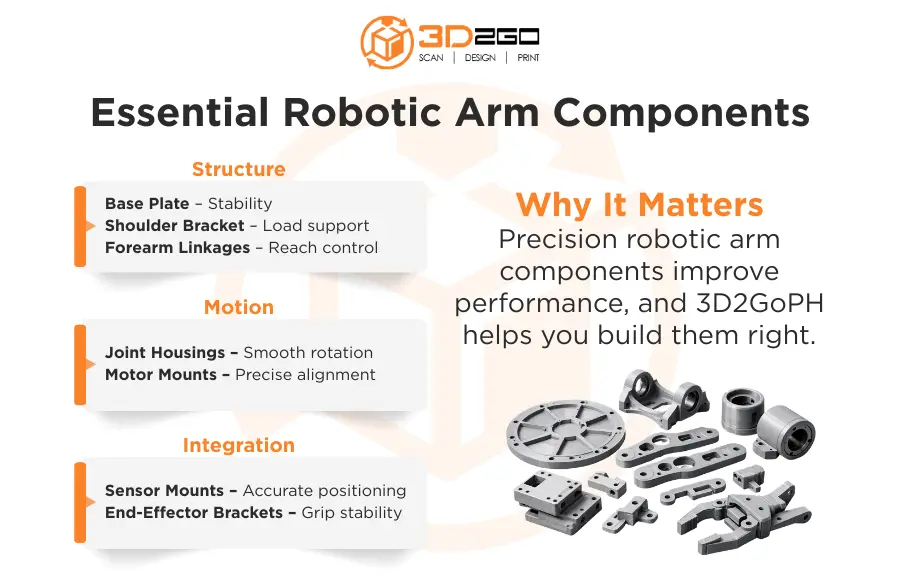
That’s why experienced builders focus early on getting robotic arm components right, not just “good enough,” but purpose-built for the job.
Customization Isn’t a Luxury. It’s a Necessity.
Off-the-shelf parts are convenient, sure. But robotics projects rarely fit inside standard dimensions.
Maybe your arm needs extended reach. Maybe weight reduction matters because you’re working with limited motor torque. Maybe you’re integrating sensors that don’t fit standard mounts.
This is where 3D-printed robotic arm components offer the flexibility you simply can’t get elsewhere.
Instead of forcing your design to adapt to available parts, you shape the parts around your design. Joint housings can be fine-tuned. Structural supports can be hollowed strategically to reduce weight. Mounting brackets can be adjusted by millimeters, and those millimeters matter.
That level of control often separates a functional prototype from a refined system.
Faster Iteration = Smarter Engineering
Let’s be honest: your first version won’t be perfect. No one’s is.
The advantage of using 3D printed robotic arm components is speed. If something feels off during assembly or testing, you don’t wait weeks for machining. You revise, adjust, and print again.
According to Deloitte, organizations that adopt rapid prototyping technologies accelerate product development and improve innovation outcomes. That same principle applies in robotics projects, whether you’re in a university lab or building independently.
When you can test, refine, and rebuild quickly, your final output becomes stronger by default.
Iteration isn’t a setback. It’s a strategy.
From Digital Model to Working Mechanism
One of the biggest advantages of modern 3D services is the seamless bridge between digital design and physical assembly.
You design robotic arm components in CAD. You simulate load distribution. You analyze motion paths. Then you bring that model into the real world without compromising geometry.
If a motor coupling needs tighter tolerances, you adjust the file. If a support rib needs reinforcement, you modify it and reprint it.
That tight feedback loop reduces guesswork and keeps the project moving forward. Less friction. Fewer surprises.
Choosing the Right Material Matters
Not all robotic arms serve the same purpose. Some are built for academic demonstrations. Others need to lift moderate loads or operate in lab environments repeatedly.
Material choice influences strength, flexibility, and longevity. Professional 3D printing allows robotic arm components to be produced in materials suited to your specific application, whether you need lightweight efficiency or structural durability.
Overbuilding wastes resources. Underbuilding compromises safety.
Striking the right balance is what makes a robotic arm reliable.
Supporting Student Innovation and Research
Robotics competitions and engineering capstone projects across the Philippines continue to grow. Students are building systems that sort objects, automate processes, and simulate industrial movement.
But limited access to fabrication often slows progress.
Having dependable production support for robotic arm components allows teams to focus on improving performance instead of improvising around structural weaknesses.
Better-fitting parts improve alignment. Stronger mounts enhance stability. Cleaner assemblies reduce troubleshooting during demonstrations.
And in competitive settings, those details matter more than people realize.
Preparing for Real-World Engineering
The manufacturing world has shifted. Additive manufacturing isn’t experimental anymore; it’s practical.
Students and builders who work with professionally produced robotic arm components gain hands-on experience with workflows used in modern engineering environments. They understand tolerances. They see how digital models translate into physical constraints. They learn what works and what doesn’t.
That exposure builds stronger engineers.
Turning Concepts Into Working Robotics
At the end of the day, robotics isn’t just about coding motion. It’s about building mechanisms that move the way they’re meant to.
Well-designed robotic arm components transform theoretical designs into functional systems. They reduce instability. They improve repeatability. They create confidence during testing and demonstration.
If the foundation is weak, no amount of programming can compensate.
If the components are precise, everything else becomes easier.
Bringing Your Robotics Project to Life
Whether you’re prototyping a competition robot or developing a research model, quality fabrication makes a measurable difference.
3D2GoPH works with engineering students, robotics teams, and innovators who need accurate, dependable production support. The goal isn’t to oversell, it’s to help projects move from concept to completion without unnecessary friction.
If you’re ready to refine your design and produce reliable robotic arm components, connect with the team and start building with clarity and confidence. Because smarter robots don’t happen by accident. They’re built that way.