

Optimize Your Facility with a Professional Warehouse Scan
February 25, 2026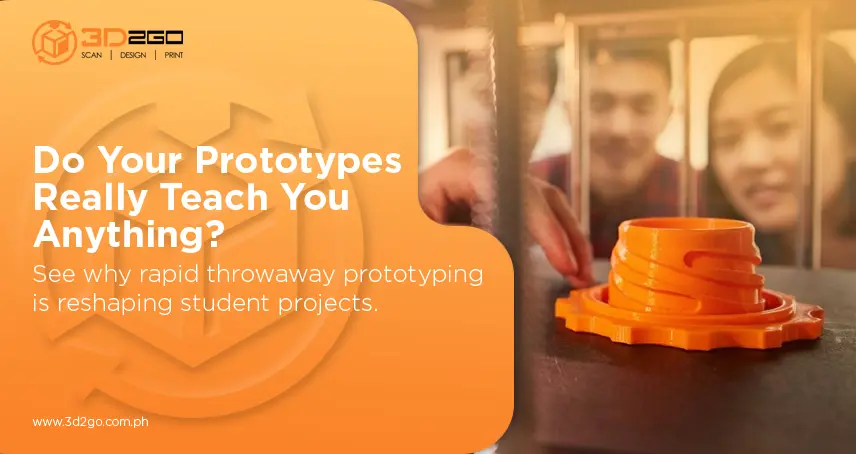
Step into a university engineering lab today, and you’ll notice something different from a decade ago. Students are no longer spending months polishing a single design before building it. Instead, they’re creating early versions, testing them quickly, learning from what breaks, and improving the next iteration.
That shift is closely tied to the growing use of quick prototyping models
In Philippine universities, rapid throwaway prototyping is no longer just a method; it is a way of life. It has become a mindset. And for engineering students working under tight academic deadlines, that mindset makes all the difference.
What Rapid Throwaway Prototyping Really Means in School Projects
Rapid throwaway prototyping is the process of building a fast, temporary model to test an idea, knowing it will likely be revised or replaced. The goal is not perfection. The goal is feedback.
For students, that distinction matters.
Academic projects often evolve mid-semester. A robotics design might need adjustments once motors are tested. A structural concept might reveal weak points during physical assembly. Instead of investing heavily in a final version too early, rapid throwaway prototyping allows students to explore safely.
They build.
They test.
They refine.
That loop encourages learning through action rather than waiting for final evaluation.
Why Iteration Works Better Than Overplanning
In theory, students could perfect everything in software before printing or fabricating. In reality, physical builds behave differently from digital simulations.
Rapid throwaway prototyping closes that gap.
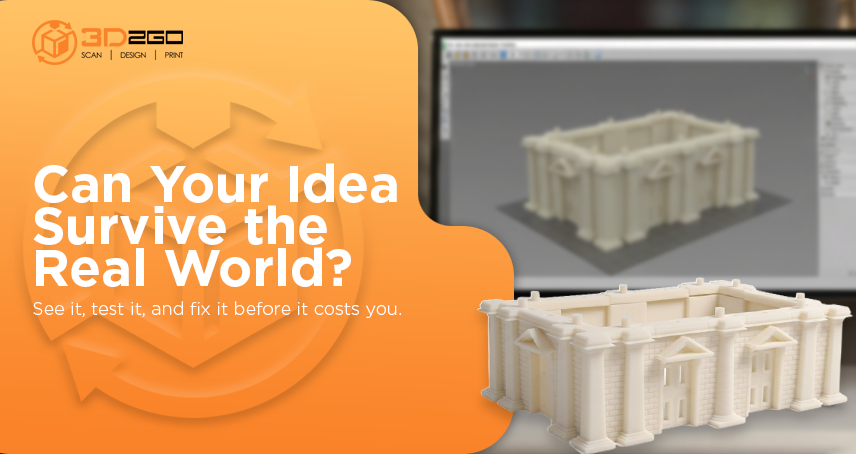
When students produce early-stage models, they can validate real-world concerns such as alignment, weight distribution, load resistance, and part interaction. What looks clean on screen can reveal hidden flaws in physical form.
This approach reduces late-stage surprises and strengthens final output. It also builds practical problem-solving skills that are difficult to develop through theory alone.
Robotics and Capstone Projects Drive Adoption
One of the strongest drivers of rapid throwaway prototyping in the Philippines is robotics education. Robotics teams deal with compact assemblies, tight tolerances, and moving components that must work together seamlessly.
A slight misalignment can cause motor strain. A poorly fitted housing can disrupt rotation. These are not issues students want to discover days before the presentation.
By using rapid throwaway prototyping early, robotics teams can test spacing, casing fit, and structural supports in advance. The same applies to capstone engineering projects where mechanical parts, enclosures, and mounting systems must function together.
Students who iterate early often produce stronger final builds because they’ve already worked through the weaknesses.
Speed Aligns with Modern Engineering Practices
The engineering industry itself has shifted toward iterative development. Companies no longer follow strictly linear design cycles. They experiment, refine, and optimize continuously.
According to Deloitte, organizations that adopt rapid experimentation and digital development processes significantly improve innovation speed and adaptability. While the study focuses on business performance, the principle applies equally to academic environments.
When students use rapid throwaway prototyping, they mirror real-world engineering workflows. They learn to value progress over perfection and testing over assumption. That experience prepares them for professional expectations after graduation.
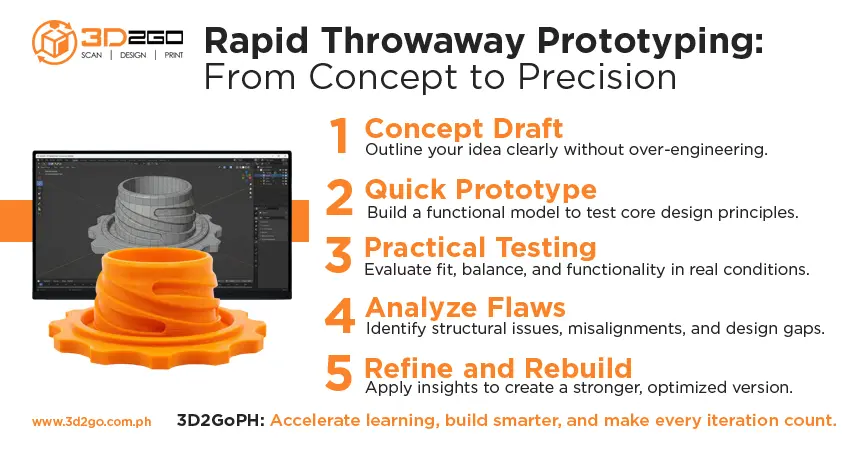
Infographic Section Visual Insert
Place this visual after discussing iteration and before exploring cost and learning impact. It reinforces how the process works in a clear, practical way.
Cost Efficiency for Students with Limited Budgets
Budget constraints are real in academic settings. Materials, components, and fabrication costs add up quickly.
Rapid throwaway prototyping helps students manage resources wisely. Early versions can be simplified or produced using cost-effective materials. Instead of committing to high-quality production immediately, students first confirm feasibility.
By the time they invest in refined builds, they do so with greater certainty. That reduces waste and improves project planning.
Building Design Confidence Through Experimentation
Students often hesitate to experiment when they fear wasting materials. Rapid throwaway prototyping changes that mindset. When early builds are expected to be temporary, experimentation becomes part of the workflow.
This freedom encourages creativity. Students test alternative geometries. They adjust structural supports. They challenge their own assumptions.
Over time, this repeated cycle of testing and refinement strengthens engineering intuition. Students begin anticipating design flaws before they occur, which improves the quality of their future work.
Connecting Classroom Theory with Practical Application
Engineering education blends mathematics, physics, and applied design. Still, there is often a gap between solving equations and building functional systems.
Rapid throwaway prototyping bridges that gap.
Load calculations turn into real bending materials. Clearance measurements reveal actual interference points. Structural analysis becomes visible and tangible.
When students physically interact with their designs, the lessons become deeper and more memorable.
Preparing for the Real Engineering Environment
Industry rarely rewards rigid thinking. It values adaptability.
Students trained in rapid throwaway prototyping develop a comfort level with iteration. They understand that early versions are stepping stones, not failures. They grow accustomed to refining designs based on feedback.
That mindset aligns closely with modern product development cycles, where testing and revision are standard.
Graduates who have practiced rapid throwaway prototyping enter the workforce with practical experience in iterative problem solving.
Why Reliable Prototyping Support Matters
While campus laboratories provide access to tools, not all facilities offer consistent turnaround time or high-precision output. Delays in prototype production can slow iteration cycles and compress project timelines.
Dependable rapid prototyping support enhances the effectiveness of rapid throwaway prototyping. When students receive accurate builds quickly, they can maintain momentum and focus on design improvements rather than fabrication challenges.
Access to professional-level production can elevate academic projects from experimental to impressive.
Supporting Student Innovation with 3D2GoPH
3D2GoPH understands the academic pressure students face during robotics builds, research projects, and capstone development. Timelines are tight, and precision matters.
By providing reliable, rapid-prototyping solutions that support throwaway prototyping, these solutions help students smoothly and confidently move through multiple design iterations.
Strong engineering ideas deserve the chance to be tested properly. When iteration is supported by dependable production, learning becomes more efficient, and results become stronger.