

Bring Campus Designs to Life with Diorama School Building Models
February 12, 2026
Restore Mobility with Custom 3D Printed Animal Prosthetics
February 16, 2026
When it comes to building a thesis prototype, the shift from theory to something you canhold changes everything. A design on a screen can look convincing, but once it’s built, tested, and handled, its strengths and weaknesses become clearer. That’s why many students are integrating physical models into their research process, especially in technical and design-driven fields.
Approaching your project as a rapid prototyping thesis means you’re validating ideas earlier instead of leaving everything to assumption. Rather than presenting a purely conceptual framework, you’re developing iterations, observing real-world performance, and refining your work before it reaches the panel.
Why Theory Alone Isn’t Always Enough
Anyone who has defended a thesis knows the drill. Panels probe the logic. They test the feasibility. They look for weaknesses. If your work lives only in slides, you’re left explaining every moving part verbally.
A rapid prototyping thesis provides something stronger than explanation: demonstration. Instead of saying, “This mechanism should function this way,” you can show it functioning. Instead of describing spatial relationships, you can let evaluators see them instantly.
What Rapid Prototyping Actually Looks Like
Let’s be clear: rapid prototyping doesn’t mean rushing. It means working in cycles.
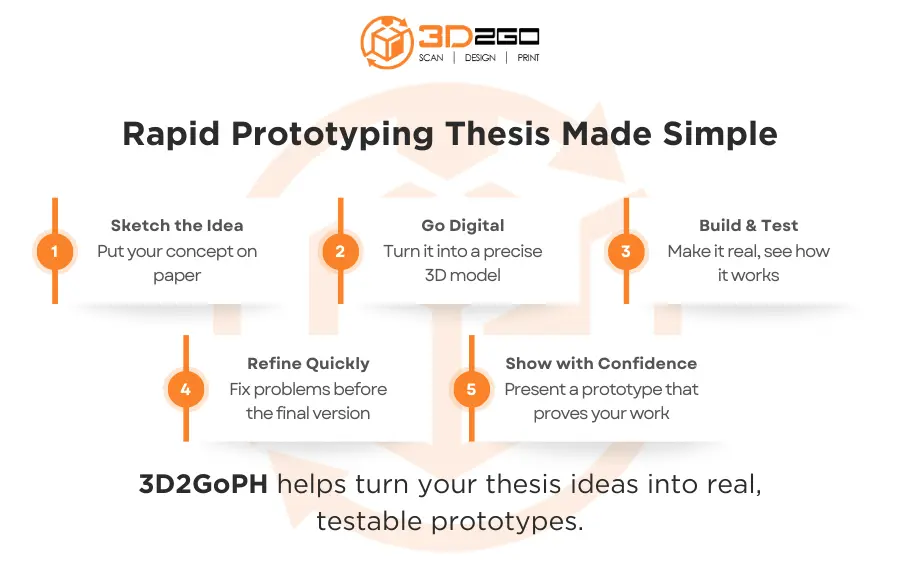
You start with a concept. You model it digitally. You fabricate an early version. Then you test it. What works? What doesn’t? What needs adjustment?
That loop, design, build, evaluate, refine, is the backbone of a strong rapid prototyping thesis. Each version gets sharper. More stable. More aligned with your research objectives.
By the time you reach final defense, you’re not presenting a first attempt. You’re presenting a tested solution.
Where It Makes the Biggest Impact
A rapid prototyping thesis can elevate projects across disciplines:
- Engineering: Demonstrating mechanical systems or device functionality
- Architecture: Showing scaled structural layouts with accurate proportions
- Industrial Design: Testing ergonomics and usability physically
- Technology & Innovation: Validating product concepts through real interaction
In each case, the physical model becomes part of your methodology. It’s not decoration. It’s evidence.
The Confidence Factor
There’s something powerful about being able to say, “Here it is,” and place your prototype in front of the panel.
A rapid prototyping thesis doesn’t just strengthen your research; it strengthens your delivery. When tough questions come, you’re not scrambling for hypothetical explanations. You can refer directly to the model. You can demonstrate. You can clarify visually.
That kind of confidence shows.
Saving Time by Building Early
It may sound counterintuitive, but building sooner often saves time later. Students who delay fabrication until the last minute risk discovering design flaws when there’s no room to fix them.
With a rapid prototyping thesis, issues surface earlier. Maybe a joint doesn’t align. Maybe dimensions need scaling. Maybe the material choice isn’t ideal. These discoveries are valuable. They strengthen your findings and demonstrate analytical depth.
Instead of defending a concept that hasn’t been physically tested, you’re defending a solution that has evolved.
Improving Your Documentation
Iteration isn’t just practical; it’s academically useful. Each version of your prototype can be documented in your research methodology. You can discuss why certain adjustments were made and how they improved performance.
That transparency adds weight to your work. A rapid prototyping thesis doesn’t just present a final product; it shows a process of critical thinking.
Bridging Academic and Real-World Practice
In professional environments, product development rarely happens in a single draft. Companies build, test, revise, and repeat. The same principle applies in academia.
By completing a rapid prototyping thesis, you’re practicing the same iterative design approach used in engineering firms, design studios, and tech startups. That experience carries beyond graduation. It becomes part of your skill set.
Employers notice candidates who can translate ideas into functional prototypes. It signals initiative and practical competence.
Getting the Fabrication Right
Of course, the quality of your prototype matters. Precision, material strength, and finishing all affect how your work is perceived. A well-built model reinforces credibility. A poorly executed one can distract from otherwise strong research.
That’s why many students collaborate with professionals who understand fabrication standards and deadlines. Accuracy and presentation quality aren’t afterthoughts; they’re part of the overall impact of a rapid prototyping thesis.
Making Your Research Stand Out
At its core, a thesis answers a question. But the way you present that answer can determine how memorable it is.
A rapid prototyping thesis moves your work from theoretical to tangible. It shows initiative. It demonstrates testing. It reflects real effort in refining your solution.
For students who want to present clearly and confidently, prototyping isn’t just helpful; it’s essential. It’s strategic.
Bringing Your Thesis to Life
A strong, rapid-prototyping thesis requires more than a good idea; it requires accuracy, appropriate materials, and reliable fabrication. Working with the right technical partner helps ensure your prototype is built to scale, functions as intended, and is presentation-ready. From digital modeling to precise production, every step supports your research objectives and timeline.
3D2GoPH helps students turn complex concepts into well-crafted, defense-ready prototypes. With professional fabrication support, you gain better build quality, clearer demonstrations, and a stronger overall presentation, giving your thesis the practical validation it deserves.