

Miniature Map Models for Museums and Tourism Exhibits
March 25, 2026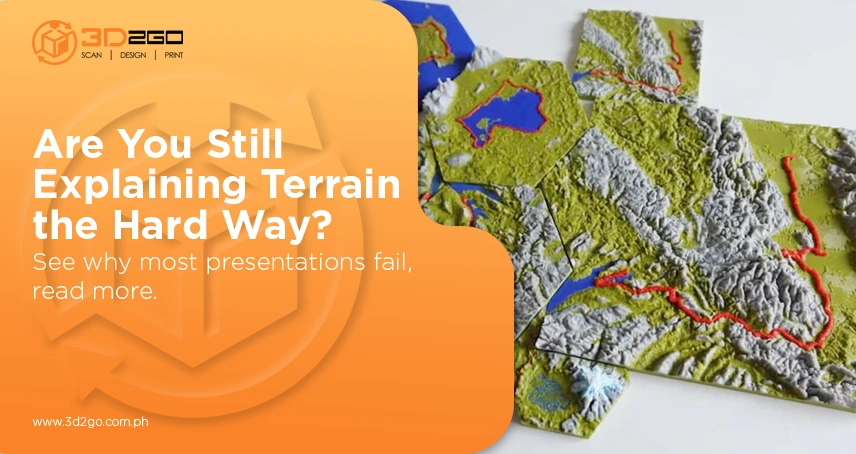
Turning geography into something you can actually understand.
Try explaining a mountain range, a coastal development, or a multi-level site using a flat map. It rarely works. Lines blur, elevations get lost, and what should be obvious becomes confusing fast. That’s exactly why more industries are turning to a miniature terrain model to make sense of complex environments.
A 3d miniature landscape doesn’t just show terrain, it translates it. Slopes become visible, distances feel real, and relationships between elements finally click. Whether it’s for real estate, tourism, or infrastructure planning, these models make complex terrain easier to present, understand, and approve.
In this article, we’ll break down how a 3d miniature landscape works, why it’s effective, and where it delivers the most value.
What Is a 3D Miniature Landscape Model?
A 3d miniature landscape is a scaled, physical representation of terrain that includes elevation, landforms, structures, and environmental details. Built at ratios like 1:500 or 1:1000, these models compress large areas into a format that’s easy to view and understand at a glance.
Unlike 2D maps or digital renders, a physical model introduces depth. You don’t have to imagine how a slope behaves or how structures sit within a space; you can see it instantly. That’s the difference.
Where flat plans rely on interpretation, a 3d miniature landscape delivers clarity upfront.
Why Complex Terrain Is So Hard to Explain
Terrain isn’t just about location; it’s about elevation, flow, and spatial relationships. And those elements don’t translate well on paper.
Traditional methods fall short in a few key ways:
- Elevation is abstract: Contour lines require technical knowledge to interpret.
- Scale is hard to grasp: Distances and proportions don’t feel intuitive.
- Spatial relationships are unclear; it’s difficult to see how the elements interact.
This creates friction, especially when presenting to stakeholders who aren’t technical. Misunderstandings lead to delays, revisions, or, worse, poor decisions.
A 3d miniature landscape removes that friction by making terrain visible, not theoretical.
How 3D Miniature Landscape Models Solve the Problem
The strength of a 3d miniature landscape lies in its ability to simplify complexity without losing detail.
Instead of asking viewers to interpret, it shows them:
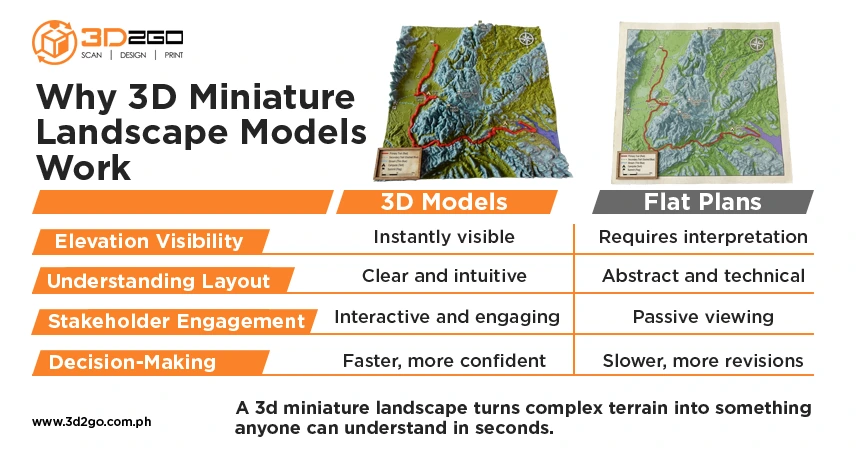
- Elevation becomes instantly visible through physical height differences
- Layouts and positioning are easy to follow
- Natural and built environments are seen in context
This shift, from interpreting to seeing, makes a huge difference.
Stakeholders don’t need technical backgrounds to understand what’s in front of them. Decisions happen faster. Feedback becomes clearer. And projects move forward with fewer revisions.
That’s why a 3d miniature landscape is more than a visual tool, it’s a communication advantage.
Where 3D Miniature Landscape Models Deliver the Most Value
Real Estate Development
Developers use a 3D miniature landscape to present entire projects so investors and buyers can immediately grasp them. Instead of explaining layouts, they show them.
This helps:
- Speed up investor decisions
- Improve buyer confidence
- Showcase surroundings and amenities clearly
Tourism and Destination Planning
Tourism relies heavily on experience, and that starts with visualization. A 3d miniature landscape allows stakeholders to see the full scope of a destination before it’s even built or promoted.
It helps tourism planners:
- Present scenic layouts convincingly
- Attract investors and partners
- Highlight key attractions and flow
Urban Planning and Infrastructure
For urban planners, clarity is critical. A 3d miniature landscape reveals how roads, structures, and green spaces interact within a terrain.
This supports:
- Regulatory approvals
- Early identification of design issues
- Better communication with communities and stakeholders
How 3D Miniature Landscape Models Are Created
Behind every accurate 3d miniature landscape is a structured, detail-driven process.
1. Data Collection
Terrain data is gathered using surveys, GIS, or LIDAR scanning to ensure accuracy.
2. Digital Modeling
The terrain is recreated in CAD or GIS software, allowing adjustments and optimization before production.
3. Scaling and Preparation
The model is scaled to fit a manageable size while preserving critical details.
4. Production
Using 3D printing or manual techniques, the terrain is built layer by layer.
5. Finishing and Assembly
Painting, texturing, and detailing bring the model to life, making it visually realistic and presentation-ready.
Each step ensures the final 3d miniature landscape is not only accurate but also easy to understand.
Technologies Behind Modern Landscape Models
Today’s 3d miniature landscape models combine multiple technologies to achieve precision and realism:
- 3D Printing: Enables accurate, scalable terrain reproduction
- LIDAR and GIS: Captures real-world terrain data
- Handcrafted Detailing: Adds realism through textures and finishing
- Advanced Materials: Resin and nylon ensure durability and quality
The combination of digital precision and physical craftsmanship is what makes modern models so effective.
Industry Trends Driving Adoption
The rise of physical modeling is closely tied to advancements in additive manufacturing. According to research, the global additive manufacturing market reflects strong demand across industries.
This growth signals a shift toward tools that improve clarity, efficiency, and sustainability.
Key trends include:
- Increased demand for physical visualization in planning and development
- Greater use of 3D printing for accurate terrain modeling
- A focus on reducing waste through efficient production methods
As projects become more complex, the need for clear, tangible communication tools, such as a 3D miniature landscape, continues to grow.
Why Businesses Are Making the Shift
More organizations are moving away from flat plans and digital-only presentations. The reason is simple: they don’t communicate well enough.
A 3d miniature landscape offers:
- Faster understanding across all stakeholders
- Stronger engagement during presentations
- Fewer revisions and misinterpretations
- Better overall decision-making
In competitive industries, clarity isn’t optional; it’s an advantage.
Bringing Terrain to Life
A 3d miniature landscape does more than represent terrain; it makes it understandable, accessible, and actionable.
When complex environments are reduced to something tangible, communication improves. Decisions become faster. And projects move forward with confidence.
If you’re looking to present terrain in a way that truly connects with your audience, it’s time to move beyond flat visuals.
For professionally crafted models that deliver clarity and precision, contact 3D2GoPH today.