

Bring Your Vehicle Dioramas to Life with 3D Printed Scale Models
January 22, 2026
Why 3D Architecture Building Models Remain Essential in Modern Philippine Design
January 26, 2026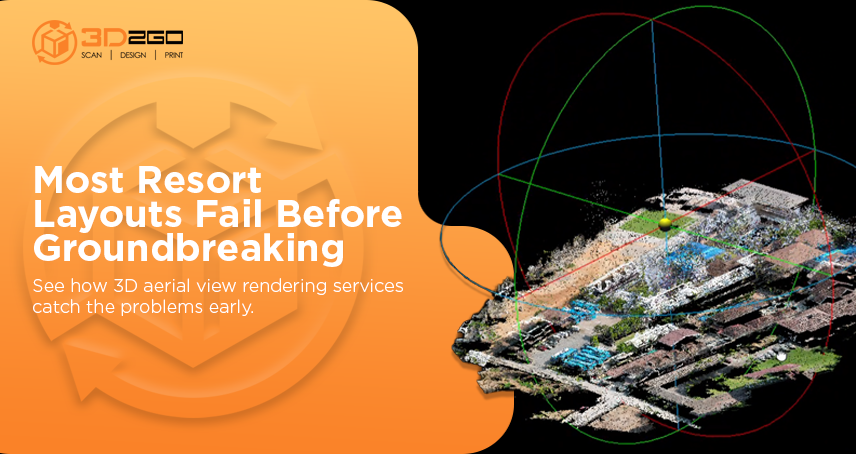
Designing a resort is rarely about a single building. It’s about how everything fits together: land, views, pathways, and experiences. That’s why aerial view rendering has become a turning point for planners and developers, especially when paired with accurate Philippine LiDAR services. Instead of imagining how a property might work, teams can now see how it actually comes together, long before construction begins.
In the Philippine resort scene, where terrain, coastlines, and environmental factors all play a role, 3d aerial view rendering services are no longer a “nice-to-have.” They’ve become a practical way to reduce guesswork, align teams, and shape smarter designs from day one.
Seeing the Land as It Really Is
Every resort starts with land, but land rarely behaves the way flat drawings suggest. Slopes, elevations, tree lines, and access points all influence how a resort should be planned. Traditional site plans often flatten these details, making it easy to miss how the terrain truly affects design choices.
With 3d aerial view rendering services, the land isn’t simplified; it’s revealed. Designers can study how buildings sit naturally on the site, how water might flow during heavy rains, and where views are strongest or weakest. This clarity allows planners to work with the landscape instead of forcing designs onto it.
For Philippine resorts built near coastlines or hillsides, that difference matters.
Making the Complex Clear for Everyone
Resort planning usually involves many voices. Architects, investors, engineers, and local stakeholders all need to understand the vision. The problem? Not everyone reads technical drawings the same way.
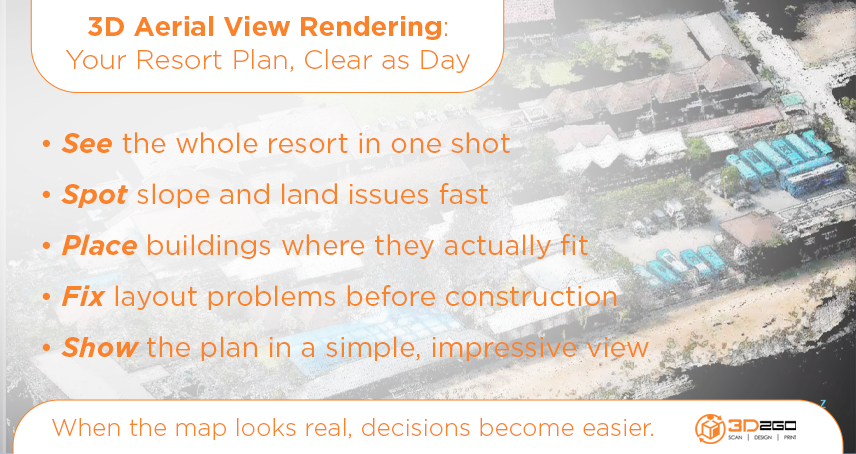
This is where 3d aerial view rendering services quietly solve a major communication gap. A single aerial visual can explain the entire layout at once, where amenities sit, how guests move, and how spaces relate to each other. Instead of long explanations, conversations become more focused and grounded in something everyone can see.
Designing for Flow, Not Just Form
A resort isn’t experienced from a blueprint. It’s experienced through movement, arrival, walking paths, transitions between spaces. These are hard to judge from isolated drawings.
By using 3d aerial view rendering services, designers can evaluate how guests move through the property as a whole. Are villas too close together? Do pathways feel intuitive? Is there a natural flow from rooms to leisure areas?
Aerial visuals help answer these questions early. Small layout adjustments made at this stage can significantly improve the guest experience without adding complexity or cost later.
Supporting Smarter Environmental Decisions
Sustainable resort design isn’t only about materials. It starts with how a site is planned. Poor placement can disrupt drainage, vegetation, or natural buffers.
Because 3d aerial view rendering services often work from accurate terrain data, they allow teams to see how development affects the land as a system. Designers can adjust layouts to minimize disruption, preserve natural features, and plan responsibly.
In a country like the Philippines, where environmental sensitivity is increasingly important, this approach supports long-term project viability rather than short-term gains.
Reducing Risk Before Construction Starts
Once construction begins, changes become expensive. What’s overlooked during planning often shows up later as delays, redesigns, or compromises.
Using 3d aerial view rendering services, teams can test ideas digitally first. They can catch spacing issues, access problems, or inefficient layouts early, when changes are still simple. This proactive approach doesn’t just save money, it saves momentum.
For resort developers juggling timelines, budgets, and expectations, that kind of foresight is invaluable.
Why Philippine Resorts Are Moving This Way
Across the country, more developers are adopting 3d aerial view rendering services because they offer something traditional tools don’t: context. These visuals don’t replace architects or engineers—they support better decisions across the board.
From early feasibility studies to investor presentations, aerial renderings create a shared understanding of what’s being built and why it works. That shared understanding often becomes a competitive advantage in a crowded tourism market.
Where 3D2GoPH Fits In
At 3D2GoPH, 3d aerial view rendering services are approached as planning tools, not just visuals. The focus is on accuracy, relevance, and real-world application, helping resort teams see potential issues early and communicate ideas clearly.
By combining local terrain knowledge with precise digital workflows, 3D2GoPH supports resort projects that value clarity, efficiency, and thoughtful design from the start.
Where Clear Planning Begins
Resort projects succeed when uncertainty is reduced early. If you’re working on a resort and want a clearer way to plan, explain, and refine your layout, 3D aerial-view rendering services offer a practical starting point.
To explore how this approach can support your next project, connect with 3D2GoPH today:
Sometimes, seeing the entire site clearly is what makes the right decision obvious.