
From Concept Art to Shelf Display: The Value of Custom 3D Figures as Modern Keepsakes
March 4, 2026
Walk past a restaurant with carefully crafted artificial food models, and you’ll notice something interesting: people slow down. They pause, take a closer look, and sometimes step inside. That small moment of curiosity is exactly what many restaurants aim to create.
Today, more food businesses are turning to custom fake food display solutions to capture that attention. With professional production services such as those offered through, restaurants can transform real menu items into lifelike replicas that remain visually perfect every day. In a competitive dining environment, that kind of visual impact can make the difference between someone walking past your restaurant or walking in.
What Is a Custom Fake Food Display?
A custom fake food display is a realistic replica of a dish designed to look exactly like the real thing. These models replicate details such as color, texture, plating, and portion size. They are typically produced from durable materials such as resin, silicone, PVC, or other synthetic compounds that maintain their appearance over time.
Unlike printed photos or menu boards, these replicas provide a three-dimensional view of the food. Customers can immediately understand what a dish looks like, how large the portion is, and how it is presented.
This concept originated in Japan through a tradition known as shokuhin sampuru, where restaurants displayed lifelike food replicas in their windows. The practice quickly became popular because it helped customers choose meals with confidence. Today, the idea has expanded globally, with restaurants, cafés, bakeries, and food retailers adopting the same strategy.
Why Restaurants Are Investing More in Custom Fake Food Display
Restaurants operate in a fast-paced environment where attracting attention quickly matters. A well-crafted custom fake food display helps solve several common challenges at once.
Increasing Foot Traffic
Visual presentation directly influences consumer behavior. Research in visual merchandising shows that effective window displays can increase foot traffic by around 23 percent. When customers see an appealing representation of a dish, it sparks both curiosity and appetite.
Instead of relying solely on menu boards or signage, a 3D display provides an immediate visual experience. It allows passersby to imagine the meal before they even step inside.
Improving Customer Decision Confidence
Many diners hesitate when ordering because they are unsure what a dish will actually look like. Photos can sometimes be misleading or unclear. A custom fake food display removes that uncertainty.
Customers see the dish exactly as it is meant to be served. They understand the portion size, ingredients, and presentation without needing a detailed explanation. This clarity speeds up ordering decisions and improves customer satisfaction.
This is particularly useful in tourist areas where language differences may make menu descriptions difficult to understand. A realistic display becomes a universal visual guide.
Reducing Food Waste and Operational Effort
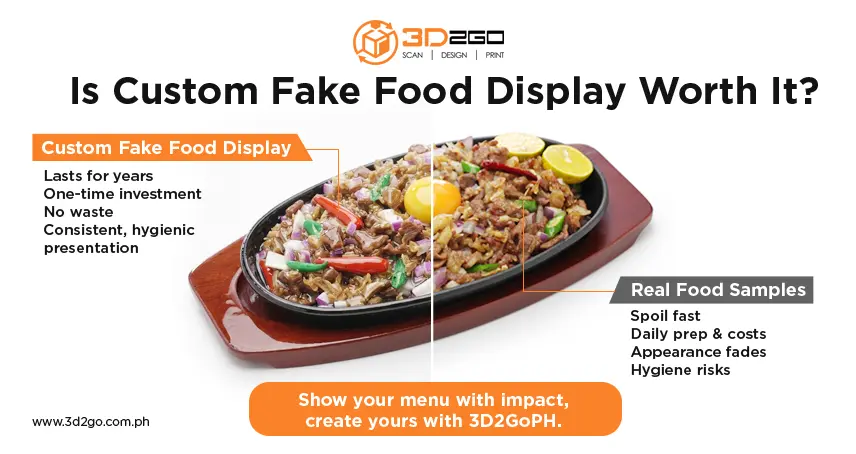
Some restaurants attempt to display real food for promotional purposes, but this approach creates ongoing problems. Real food spoils quickly, requires constant preparation, and can attract pests.
A custom fake food display eliminates these issues. Once produced, the replica maintains the same fresh appearance every day. There is no need to replace ingredients or maintain perishable samples.
Over time, this reduces waste and saves operational effort for restaurant staff.
The Role of Visual Merchandising in Restaurant Marketing
Visual merchandising is widely used in retail to influence purchasing behavior, and the same principle applies in food service. Displays help shape customer expectations and guide their choices before they even interact with staff.
Studies show that eight out of ten consumers are influenced by visual presentation in stores and restaurants.
For restaurants, this means that dishes placed in a window display often become the most frequently ordered. The display acts as a silent marketing tool that works throughout the day.
A carefully designed custom fake food display, therefore, supports both branding and sales. It reinforces the restaurant’s image while promoting specific menu items.
Supporting Consistency Across Locations
For restaurants with multiple branches, maintaining consistent presentation can be difficult. Dishes may vary slightly depending on the chef, ingredients, or plating style.
A custom fake food display provides a visual standard that each location can follow. The replica becomes a reference point for how the dish should look when served.
This approach supports brand consistency. Customers visiting different branches still recognize the same dishes and presentation style.
Consistency builds trust and strengthens brand identity over time.
A Practical Tool for Staff Training
Beyond marketing, fake food displays also have operational benefits. Restaurants often use these replicas as training tools for new staff members.
By examining the display model, employees can quickly understand portion size and plating expectations. This helps maintain uniform presentation even during busy service hours.
Because the replica never changes, it provides a stable visual guide that new team members can refer to at any time.
Why Demand for Realistic Displays Is Growing
As restaurants compete for attention in crowded dining areas, visual presentation has become more important than ever. Customers are constantly exposed to food photography on social media, raising expectations about how dishes should look.
Restaurants are responding by investing in higher-quality visual merchandising tools. A custom fake food display offers a reliable way to maintain an attractive storefront presentation without constant maintenance.
These displays are also useful for marketing campaigns, promotional photos, and themed seasonal displays. Their durability allows businesses to reuse them for years.
Choosing a Professional Production Partner
The effectiveness of a fake food display depends heavily on the quality of its design and craftsmanship. Poorly made replicas can appear unrealistic and may negatively affect customer perception.
High-quality production focuses on accurate color matching, texture detail, and realistic plating. When these elements are carefully crafted, the display becomes almost indistinguishable from real food.
Bring Your Menu to Life With a Custom Fake Food Display
Restaurants invest heavily in attracting customers, but sometimes the most effective tools are the simplest ones. A well-designed custom fake food display captures attention, improves customer confidence, and reduces operational challenges associated with real food samples.
It functions as both a marketing asset and a practical business tool. Helping customers visualize menu items clearly, it encourages faster decisions and stronger engagement with the brand.
For restaurants looking to strengthen their storefront presentation and create a lasting visual impression, partnering with experts like 3D2GoPH can make a significant difference.