

The Rise of 3D Printing Low Volume Production in the Philippines’ Smart Manufacturing Era
January 19, 2026
How LiDAR Mapping Is Transforming Building Documentation and Planning in the Philippines
January 21, 2026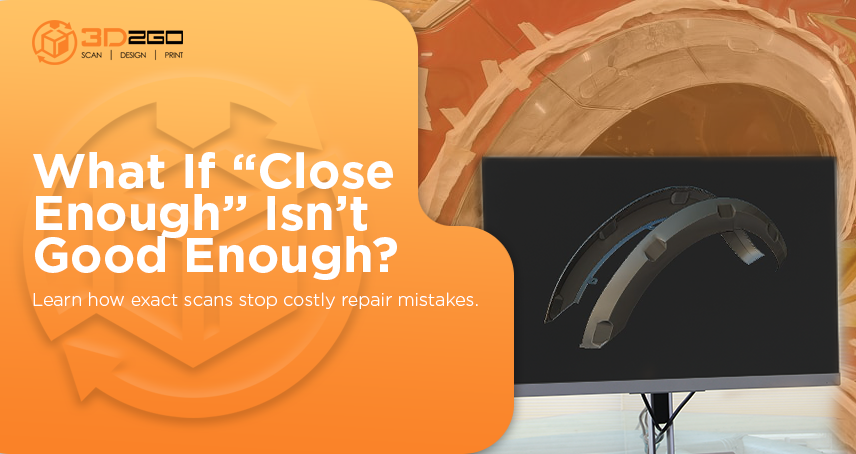
Every vehicle tells a story. Some come in with minor wear, others with collision damage or parts that no longer exist in catalogs. The challenge has always been the same: how do you fix something accurately when measurements are off, parts are unavailable, or nothing fits quite right?
That’s where automotive 3D scanning starts to change the conversation. Instead of relying on visual checks and manual tools, repair teams now capture the exact shape of a vehicle or component, down to the smallest curve. This shift is why 3d scanning for automotive work is becoming a practical necessity, not a “nice-to-have,” especially across workshops and fabrication teams in the Philippines.
Why Traditional Measurements Often Fall Short
Anyone who’s worked on vehicle repairs knows the frustration. Two parts may look identical on paper, but once installed, something’s off. A panel doesn’t sit flush. A bracket needs adjustment. Time gets burned fixing problems that shouldn’t have happened in the first place.
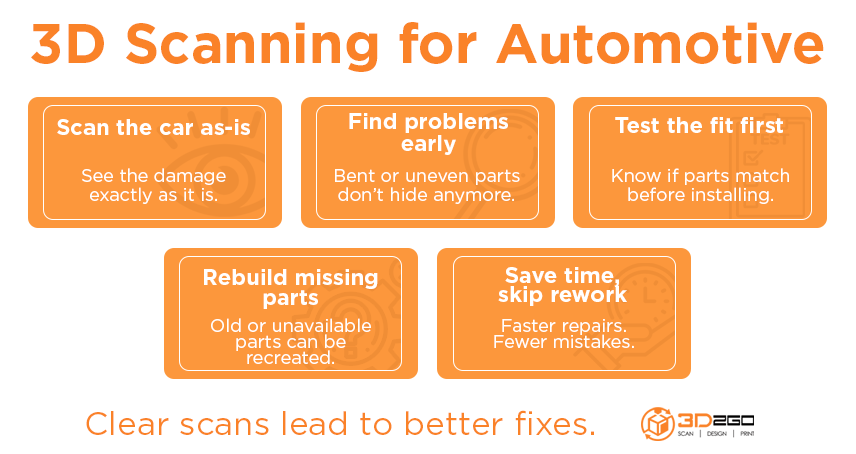
Manual measuring tools struggle with complex surfaces, uneven wear, and custom modifications. 3d scanning for automotive applications solves that gap by capturing real-world geometry exactly as it exists, not how it’s supposed to look in theory.
Once a component is scanned, technicians can work from precise digital data instead of educated guesses. That alone can save hours per repair job.
Faster Repairs Without Cutting Corners
Speed matters, but not at the expense of quality. Vehicles stuck in the shop too long affect schedules, customer satisfaction, and revenue. One of the quiet advantages of 3d scanning for automotive repair is how much time it saves across the entire workflow.
Instead of repeatedly fitting and refitting parts, teams measure once and reuse the data. Scans can be referenced during design, fabrication, and installation. That reduces backtracking and keeps projects moving.
When Parts Are Hard to Find or Don’t Exist Anymore
Older vehicles, imported models, or specialty units often come with a familiar problem: replacement parts aren’t readily available. Waiting weeks for shipments isn’t always an option, and improvising parts introduces risk.
With 3d scanning for automotive solutions, damaged or worn components can be scanned and digitally recreated. That data can then be used for CNC machining or 3D printing, producing parts that match the original geometry far more accurately than manual reverse engineering.
For repair shops, this means less downtime and more control. For vehicle owners, it means repairs that don’t stall indefinitely.
Better Part Matching Starts Before Installation
Fitment issues rarely show up on spec sheets; they appear during installation. A few millimeters off can mean the difference between a smooth repair and hours of adjustment.
By using 3d scanning for automotive part matching, teams can digitally compare existing components with replacements before anything is installed. Misalignments are spotted early, not halfway through the job.
This approach reduces waste, prevents forced fittings, and helps ensure the final result looks and performs as it should.
Collision Repair Gets More Precise
Collision damage isn’t always obvious. Even when panels appear straight, structural shifts can lie beneath. Relying on visual inspection alone leaves room for error.
3d scanning for automotive collision repair allows technicians to map damaged areas against reference models. Subtle deviations become visible, making it easier to plan corrections and verify that repairs restore proper alignment.
This level of clarity is especially useful when documentation matters, such as insurance claims or compliance checks.
A More Connected Way to Work
One reason 3d scanning for automotive keeps gaining traction is how well it fits into modern workflows. Once a scan is captured, it’s easy to share with designers, fabricators, or decision-makers; there’s no need for repeated physical inspections.
Scanned data can be used to:
- Validate designs before production
- Create custom mounts or fixtures
- Support faster approvals and clearer communication
It’s a smoother way to move from diagnosis to solution without unnecessary delays.
Why Local Expertise Matters
Technology alone doesn’t solve problems; how it’s applied does. Vehicle conditions, road environments, and usage patterns in the Philippines create repair challenges that generic solutions often overlook.
Working with a local provider ensures 3d scanning for automotive services is applied with real-world context in mind. That includes handling customized vehicles, fleet units, and region-specific models with more confidence and accuracy.
Repair Work Without the Guesswork
As vehicles become more complex, relying solely on manual methods isn’t enough. Precision, speed, and adaptability now define successful automotive repair.
By integrating 3d scanning for automotive processes, repair teams gain clearer insights, better-fitting parts, and smoother workflows. The technology doesn’t replace skilled hands; it supports them with better information.
For teams ready to move away from trial-and-error and toward precise, data-backed repairs, 3D2GoPH offers professional scanning solutions built for real automotive challenges.