

The Benefits of Using LiDAR in Disaster Preparedness and Flood Monitoring Initiative
January 16, 2026
How 3D Scanning Improves Automotive Repair and Part Matching in the Philippines
January 20, 2026
Smart manufacturing isn’t just a trend anymore. It’s the way modern companies stay flexible, fast, and competitive. And one of the biggest shifts happening right now is the rise of 3D printing low volume production.
Instead of waiting for long lead times and expensive tooling, businesses are now producing small batches of parts and products quickly and efficiently. This is a big deal, especially in the Philippines, where companies are increasingly adopting smarter methods to reduce costs and speed up product launches.
If your team is still stuck in traditional manufacturing, this kind of change can completely transform your operations.
Why Low Volume Production Is More Practical Than Ever
Traditional manufacturing makes sense when you’re producing thousands or millions of identical parts. But what if you only need a few dozen? Or what if your product is still evolving?
That’s where 3D printing low-volume production becomes a real advantage.
With traditional methods, small runs are expensive. Tooling costs alone can delay projects or force companies to order more than they actually need. With 3D printing, those barriers disappear.
You can create:
- Prototypes for testing
- Limited edition products
- Custom components
- Replacement parts for older equipment
And you can do all of this without committing to large orders or spending a fortune.
What Smart Manufacturing Looks Like in Practice
Smart manufacturing is about more than just speed. It’s about making decisions based on real data and adapting quickly when things change. 3D printing for low-volume production fits perfectly into this approach.
Here’s how it works in real life:
Faster testing and iteration
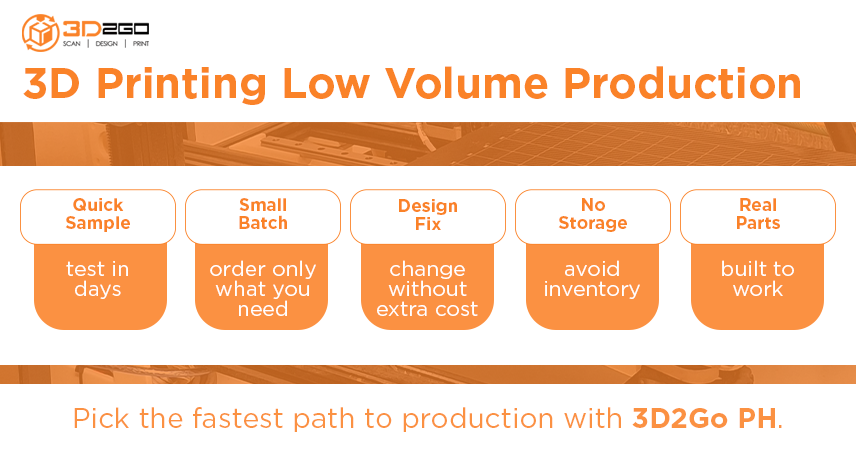
Instead of waiting weeks for a sample part, you can get it in days. This means you can test, adjust, and retest without slowing down the entire project.
Lower risk, higher confidence
When you can produce small batches, you’re not locked into a single design. You can refine products based on feedback without wasting money on mass production.
More flexibility
Need a custom part for a specific machine? Or a unique product for a niche market? 3D printing lets you create exactly what you need, without compromise.
This is why 3D printing low volume production is becoming a key part of smart manufacturing strategies in the Philippines.
The Real Cost Savings Are Often Hidden
Many businesses don’t realize how much traditional manufacturing actually costs. The product’s price is only part of the story.
When you use 3D printing low volume production, you can reduce:
- Tooling and mold expenses
- Storage costs
- Overproduction waste
- Production delays
- Risk of unsold inventory
In other words, it’s not just cheaper, it’s smarter.
A Deloitte report shows that companies using agile manufacturing methods can cut time-to-market by up to 30%. That kind of speed can be the difference between winning and losing in a competitive market.
Quality Has Improved
One common misconception is that 3D printing can’t match the quality of traditional manufacturing. That used to be true, but not anymore.
Modern 3D printing technologies can produce parts that are strong, accurate, and durable. And with proper finishing, they can look and feel like traditional parts too.
That means 3D printing low volume production isn’t just for prototypes anymore. It’s being used for real, functional parts and products across multiple industries.
Why the Philippines Is Becoming a 3D Printing Hub
The Philippines is quickly becoming a strong contender in the manufacturing landscape. One major advantage is cost-efficiency, and that makes 3D printing low volume production even more attractive.
Businesses can outsource their production needs without sacrificing speed or quality. This is especially useful for:
- Startups testing new products
- Companies scaling up operations
- Manufacturers needing fast replacement parts
- Teams that need custom components
This flexibility is why more companies are choosing 3D printing over traditional production methods.
Where 3D Printing Low Volume Production Makes the Biggest Impact
Some industries benefit more than others from low volume production. These include:
Industrial Equipment
When machines break down, waiting for replacement parts can bring operations to a halt. 3D printing enables the rapid production of replacement components.
Product Development
Companies can test product concepts faster and refine designs before mass production.
Custom Manufacturing
If you need specialized parts or limited editions, 3D printing is ideal.
Consumer Goods
Small batch production helps brands test new products without risking large inventory.
In each case, 3D printing low volume production reduces risk and speeds up decision-making.
Why Your Business Should Consider It Now
If you’re still relying on traditional manufacturing for everything, you might be losing time and money without even realizing it.
3D printing low volume production gives you the ability to:
- Move faster
- Test smarter
- Reduce costs
- Keep operations flexible
- Produce parts on demand
It’s a more modern way of working, and it’s quickly becoming the standard.
Take the Next Step Without Guesswork
If you want to stay competitive in 2026 and beyond, you need production methods that keep pace with today’s pace.
3D2GoPH offers 3D printing low volume production that helps you move faster, reduce risk, and keep costs low. Whether you need prototypes, small batch production, or custom parts, we can support your project with fast turnaround and professional results.