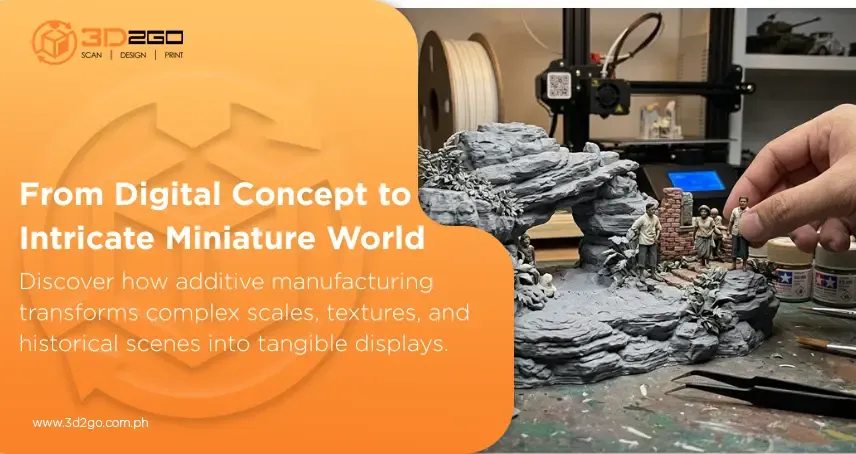
Anyone who builds scale models, designs museum exhibits, or crafts tabletop terrain knows the pain of traditional diorama building. Recreating a scene from scratch used to mean hacking away at foam blocks, cutting balsa wood, or kitbashing off-the-shelf plastic sets that never quite matched what you had in mind. If your display called for a specific architectural arch, a custom vehicle chassis, or a unique terrain texture, finding the right piece ready-made was practically impossible.
Modern 3D printing changes that game entirely. Instead of settling for generic parts, creators can turn digital files into ultra-detailed physical assets on demand. Using custom 3D printed miniature models lets you capture fine textures, organic curves, and exact scale proportions that hand-carving just can’t touch. For modelers and institutions across the country, building a 3d printed diorama Philippines project offers a practical, highly flexible way to bring complex scenes to life.
Why Scale Builders Are Ditching Manual Sculpting
Handcrafted scale environments have their charm, but they come with real material headaches. Foam crumbles under light pressure, cardboard warps when the humidity spikes, and clay loses those crisp edges you need for structural facades or mechanical gear.
Switching to digital fabrication fixes those pain points right out of the gate:
- Spot-On Scale Accuracy: Digital 3D modeling lets you lock in exact ratios—whether you’re working in 1:12, 1:35, or 1:100—so every figure, vehicle, and building stays perfectly proportional across the display.
- Intricate Surface Detail: High-resolution printers capture tiny details like weathered brickwork, stone masonry, wood grain, and realistic foliage right into the print itself.
- Effortless Batch Production: Need dozens of identical wall panels or structural trusses? Digital files ensure every copy prints with the same precision.
Building a 3d printed diorama Philippines scene skips the frustrating trial-and-error of manual crafting, saving weeks of bench time while delivering a cleaner final build. Market data projects that global spending on 3D printing for consumer goods and creative modeling will surpass $5 billion, driven heavily by creator demand for custom scale replicas and bespoke display pieces.
Where Custom Dioramas Make an Impact
Miniature environments do far more than look cool on a shelf. Across different industries, setting up a 3d printed diorama Philippines display delivers real practical value:
- Museum & Cultural Exhibits: Rebuild ancient ruins, historical battlefields, or heritage sites with total accuracy for public displays and visitor centers.
- Architectural & Real Estate Models: Present planned commercial builds, housing developments, or industrial complexes to clients and city planners in physical 3D.
- Tabletop & Wargaming Terrain: Design custom terrain pieces, modular dungeon tiles, and thematic battlefields tailored to your exact campaign rules.
- Corporate & Trade Show Displays: Showcase massive industrial gear, shipping vessels, or processing plants in portable desktop scales for events and pitches.
Using a 3d printed diorama Philippines approach helps you turn flat blueprints and 3D renders into tangible models that grab attention immediately.
FDM vs. Resin: Picking the Right Tool for the Job
Different 3D printing technologies handle scale modeling in different ways. The two most common methods—Fused Deposition Modeling (FDM) and Stereolithography (Resin)—each serve a distinct purpose in a diorama build:
Fused Deposition Modeling (FDM)
FDM melts and lays down thermoplastic filament layer by layer. It’s the go-to choice for large structural bases, mountain backdrops, terrain rocks, and heavy building frames. FDM materials are tough, budget-friendly for large volumes, and hold up well under heavy structural loads.
Stereolithography (Resin)
Resin printers use UV light to cure liquid photopolymer layer by layer at micro-level resolutions. This process is essential for miniature figures, detailed machinery, fine foliage, and crisp architectural trim where you can’t afford visible layer lines.
Combining both techniques in a single 3d printed diorama Philippines build gives you the best of both worlds: rock-solid bases paired with razor-sharp surface details.
From Rough Idea to Finished Display
Turning a creative concept into a fully realized scale display takes a clear, step-by-step pipeline:
- Setting the Scale & Layout: Defining the scene’s footprint, story elements, and exact scale factor for every component involved.
- 3D Sculpting & File Prep: Sculpting custom assets in software like ZBrush or Blender, or optimizing existing CAD models for physical printing.
- Slicing & Print Setup: Configuring layer heights, orientation angles, and support trees to protect fine details while minimizing surface marks.
- Post-Processing & Clean-Up: Washing resin parts, stripping supports, sanding smooth, and applying a clean primer coat for painting.
- Painting & Weathering: Adding acrylic layers, washes, and dry-brushing before assembling the final scene with ground cover and lighting.
Following this structured workflow keeps your 3d printed diorama Philippines project on track from raw mesh to finished showcase.
Built to Handle Local Philippine Climate Conditions
Tropical weather poses a real challenge for traditional modeling materials. High humidity, warm temperatures, and direct sunlight cause paperboard, unsealed wood, and cheap clay to swell, warp, or crumble over time.
Building a 3D-printed diorama of the Philippines with durable thermoplastics (like PLA+ or ABS) or UV-cured resins creates a stable, long-lasting structure. Thermoplastics don’t absorb atmospheric moisture, while properly cured resin parts hold their exact shape for years without sagging. Top-coating your painted model with a protective matte clear coat shields it from dust and UV fading, keeping your display looking fresh for the long haul.
Bring Your Scale Visions to Life with 3D2GoPH
Building an immersive, detailed miniature world shouldn’t mean wrestling with fragile materials or settling for generic plastic kits. Getting your geometry, scale, and surface resolution right from the start gives you total creative freedom.
3D2GoPH closes the gap between digital design and physical scale models. Backed by industrial resin and FDM printers, experienced digital sculptors, and professional finishing services, our team delivers high-precision custom parts tailored to your exact project goals.
Stop settling for store-bought kits that don’t fit your layout. Skip the tedious work of hand-carving foam. Reach out to the team today, and let’s turn your diorama concepts into stunning physical reality!