
How 3D Scanning Improves Automotive Repair and Part Matching in the Philippines
January 20, 2026
Bring Your Vehicle Dioramas to Life with 3D Printed Scale Models
January 22, 2026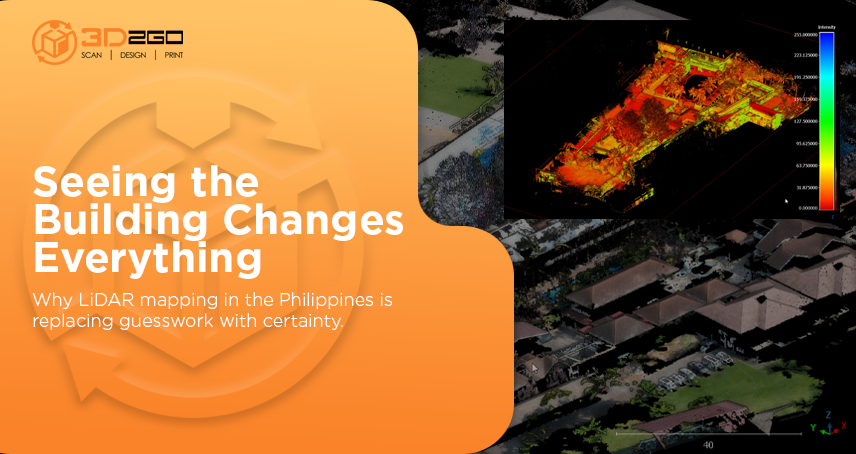
The way we plan and document buildings in the Philippines is finally catching up with the technology available today. For decades, architects, planners, and property managers have had to rely on dusty blueprints, inconsistent records, or manual measurements that often miss key details. But now, Philippine LiDAR services are stepping in to change all that, and in a big way.
Using advanced scanning techniques, teams can capture every nook and cranny of a structure in high resolution. As a result, lidar mapping philippines is redefining how buildings are recorded, analyzed, and managed across the country.
It’s More Than Just Another Survey Tool
Walk through any commercial property today, and you’ll quickly realize how messy documentation can get. Floor plans get updated manually, renovations go undocumented, and critical dimensions are left to guesswork. That kind of uncertainty makes planning renovations, retrofits, or maintenance harder than it should be.
Here’s where lidar mapping philippines makes a real difference.
Instead of relying on manual tools or outdated blueprints, LiDAR captures precise point clouds, millions of laser distances, in just minutes. Those data points are stitched together to create accurate 3D models that reflect the real conditions on the ground. No approximations. No guesswork. Just verified, usable information.
For architects, engineers, and facility managers, this is a game-changer.
Why Building Planning Needs Accurate 3D Data
Imagine designing a floor layout without seeing the exact location of columns, beams, or ductwork. Or trying to retrofit a historical building with missing records. These situations aren’t rare, they’re everyday challenges that many Filipino planners face.
Lidar mapping philippines solves this by giving teams that solid foundation of accuracy.
Once a building is scanned:
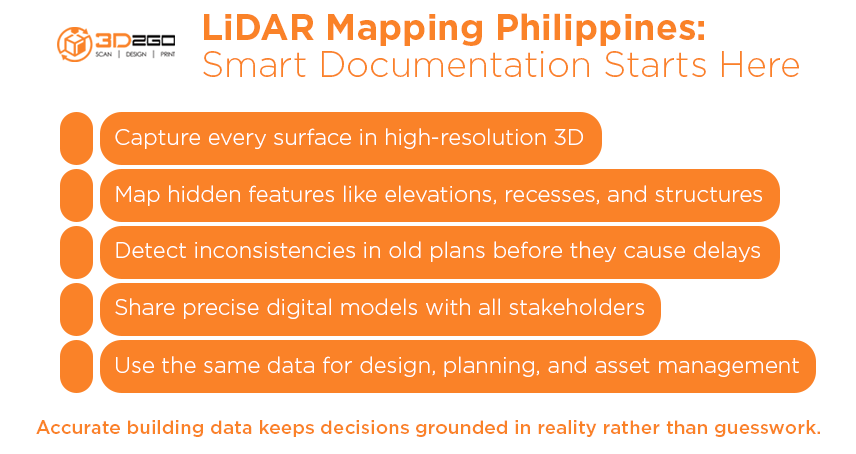
- Designers can lay out changes with confidence.
- Contractors know exactly what they’re building against.
- Facility managers can plan maintenance with accurate measurements.
- Owners can avoid costly rework due to inaccurate plans.
Instead of waiting for multiple survey days, teams can gather all the data in one go and work from a unified digital model. That’s a massive leap in efficiency.
A Real Example of Transformation
To put this in perspective, consider a large hospital building with decades of irregular modifications. Traditional surveys might take weeks and still miss hidden discrepancies. With lidar mapping philippines, the entire structure can be scanned in a fraction of that time, and the data is so precise that it can be imported directly into design and planning software.
According to research, the global LiDAR market is expected to grow significantly over the next few years, largely driven by its adoption in construction, planning, and infrastructure management.
This trend isn’t just global; it’s very much local, as more Philippine planners see the value of using real-world 3D data rather than relying on old drawings.
The Real Value of LiDAR in Everyday Workflow
LiDAR isn’t just about collecting data; it’s about changing how decisions are made.
Here’s how that plays out on the ground:
- Reduced risk of errors: Accurate measurements mean fewer surprises once construction begins.
- Better cross-team collaboration: Everyone sees the same model, whether they’re in Manila, Cebu, or Davao.
- Improved project planning: Planners can simulate changes before they touch a wall.
- Fewer site visits: With rich digital models, some decisions can be made offsite, saving time and travel costs.
These are not incremental benefits; they’re foundational improvements that make projects faster, cleaner, and better documented.
Not Just for New Buildings, Documentation Matters Long After Construction
One of the biggest misconceptions about lidar mapping philippines is that it’s only for new projects. In reality, it’s equally, if not more, valuable for existing buildings.
Think about structures that have been around for decades: malls, offices, factories, even heritage buildings. The original plans might be lost, incomplete, or inaccurate. In those cases, LiDAR gives you a digital twin, a virtual representation that matches every feature exactly as it is today.
With that digital twin, teams can:
- Plan renovations with precision
- Estimate material requirements accurately
- Improve safety audits
- Track changes over time
That’s why property managers and building owners are increasingly incorporating LiDAR into their long-term management strategies.
Faster, Smarter Decisions
When contractors, architects, and facility teams work from the same accurate 3D model, everything becomes easier. Miscommunication drops, assumptions disappear, and every decision is backed by real data.
This is the future of documentation and planning, digital, collaborative, and grounded in precision.
Why Local Expertise Matters
Technology alone isn’t enough. You need people who know how to apply it to local conditions, buildings with mixed materials, complex layouts, and site constraints that are common in Philippine urban and rural environments.
That’s where Philippine LiDAR services with local experience shine. They know how to translate raw scan data into something meaningful for planners, contractors, and building managers.
You don’t just get a data file, you get something you can actually use.
Moving Toward a Smarter Building Era
Buildings today aren’t static assets. They’re dynamic spaces that evolve, adapt, and demand more from those who design and manage them. Lidar mapping philippines is no longer a futuristic concept; it’s a tangible tool that’s reshaping how buildings are documented, planned, and maintained.
When teams work with accurate 3D data, projects move faster. Mistakes shrink. Budgets stay closer to reality. And everyone involved has a clearer line of sight into what’s happening, before a single brick is laid or a single wall is moved.
See Your Building Clearly, Every Time
If you’re planning a new construction, updating an existing property, or tightening documentation for long-term management, this is the moment to rethink how you work.
With lidar mapping philippines, you’re not just capturing measurements, you’re creating a digital record that will serve as the foundation for every future decision.
3D2GoPH is ready to help you get there with expert LiDAR capture and practical data delivery tailored to your needs.