

Architectural Scale Models in the Philippines for Area Project Visualization
February 17, 2026
Speed Up Your Project Innovation with Rapid Prototyping Equipment
February 19, 2026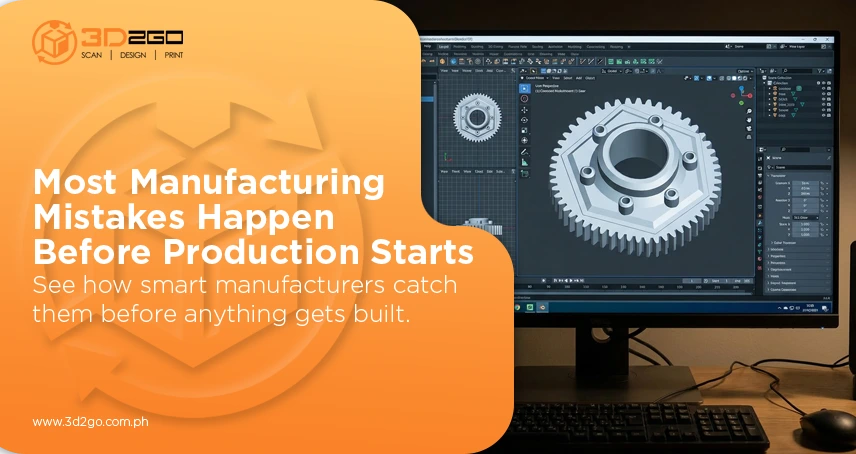
Modern manufacturing isn’t just about machines anymore; it’s about how intelligently those machines are designed, tested, and improved before anything physical is even built. That’s where machine parts modeling comes in. Companies across the Philippines are leaning into digital engineering to stay competitive, reduce costly trial-and-error cycles, and move faster without sacrificing accuracy.
At the center of this shift are 3d model mechanical parts, which turn raw engineering ideas into precise, workable digital assets. These models allow teams to simulate, refine, and validate designs long before production starts, saving time, money, and headaches. If you’ve explored advanced modeling services, you’ve probably seen how platforms like this one bridge the gap between concept and manufacturable reality.
As Industry 4.0 continues to reshape the local manufacturing landscape, the ability to design digitally is no longer a luxury; it’s becoming a baseline expectation.
From Drafting to Digital Intelligence
Traditional drafting had its place. But today’s manufacturing pace doesn’t leave much room for ambiguity. Engineers need models that don’t just look correct — they need to behave correctly under stress, motion, and assembly conditions.
That’s why 3d model mechanical parts are so valuable. These aren’t simple visual references; they’re data-rich representations that contain dimensions, tolerances, and relationships between components. Engineers can test movement, predict wear, and catch alignment issues before anything touches a production floor.
Instead of discovering problems after fabrication, teams identify them digitally. It’s a subtle shift with massive ripple effects: fewer redesign cycles, faster approvals, and greater confidence as we move into production.
Smart Manufacturing Needs Smart Models
Smart factories rely on interconnected systems, CNC machines, automation platforms, and simulation tools — all speaking the same digital language. 3D models of mechanical parts serve as a shared language, acting as the blueprint that machines execute.
When designs feed directly into manufacturing workflows, you unlock:
- Faster toolpath generation
- Accurate machining instructions
- Reduced manual intervention
- Consistent production quality
This isn’t theoretical. It’s already happening in Philippine industries, as they modernize their workflows to compete globally.
Where Philippine Industries See Real Gains
Digital modeling doesn’t just improve engineering; it reshapes how entire organizations operate.
Faster Iteration Without Physical Waste
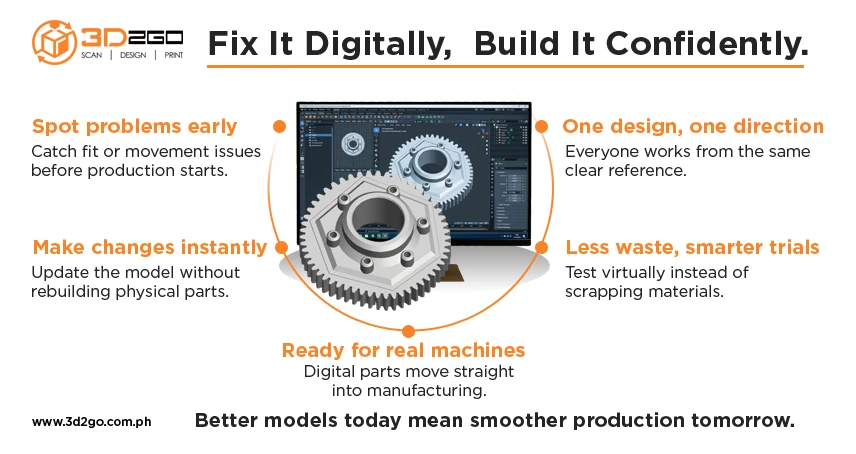
Design revisions no longer require rebuilding prototypes from scratch. With 3d model mechanical parts, teams can tweak dimensions, simulate performance, and validate assemblies instantly. That shortens development timelines while cutting material waste.
Clearer Collaboration Across Teams
Manufacturing projects rarely live in silos. Designers, machinists, procurement teams, and quality engineers all rely on shared information. Digital models act as a common reference point, minimizing misinterpretation and version confusion.
Extending the Life of Legacy Equipment
Older machinery often runs without updated documentation. Reverse engineering supported by 3d model mechanical parts allows teams to recreate critical components accurately, keeping essential systems operational without guesswork.
Building a Strong Modeling Workflow
Adopting digital modeling isn’t just about buying software; it’s about building habits and systems that support long-term efficiency.
Invest in Skilled Modelers
A model is only as useful as its accuracy. Teams that understand tolerances, manufacturability, and assembly logic create 3D models of mechanical parts that translate smoothly into production.
Establish Modeling Standards
Consistent naming conventions, revision tracking, and file structures prevent confusion and keep projects organized, especially when multiple teams are involved.
Connect Modeling to Production Systems
When digital models link with lifecycle or production software, organizations gain better visibility into revisions, costs, and resource planning.
Overcoming Adoption Barriers
Digital transitions aren’t always smooth. Resistance to change, training gaps, and data security concerns can slow progress. But these challenges aren’t roadblocks; they’re planning issues.
Gradual workflow integration helps teams adapt without disruption. Targeted training fills skill gaps. Secure platforms protect sensitive design files. Companies that approach modernization strategically often find the transition far less intimidating than expected.
And once teams see how much smoother production becomes, adoption tends to accelerate naturally.
Why This Matters Now
Manufacturing in the Philippines is evolving. Global supply chains expect faster turnaround, tighter tolerances, and higher reliability. Digital engineering is no longer an experimental upgrade, it’s the backbone of competitive production.
Organizations leveraging 3d model mechanical parts gain visibility, control, and flexibility that traditional workflows simply can’t match. They prototype smarter, collaborate faster, and manufacture with greater confidence.
For companies looking to modernize without unnecessary friction, working with specialists who understand both engineering intent and production realities can dramatically shorten the learning curve. That’s where experienced partners like 3D2GoPh bring practical value, helping businesses translate ideas into accurate, production-ready digital assets.